
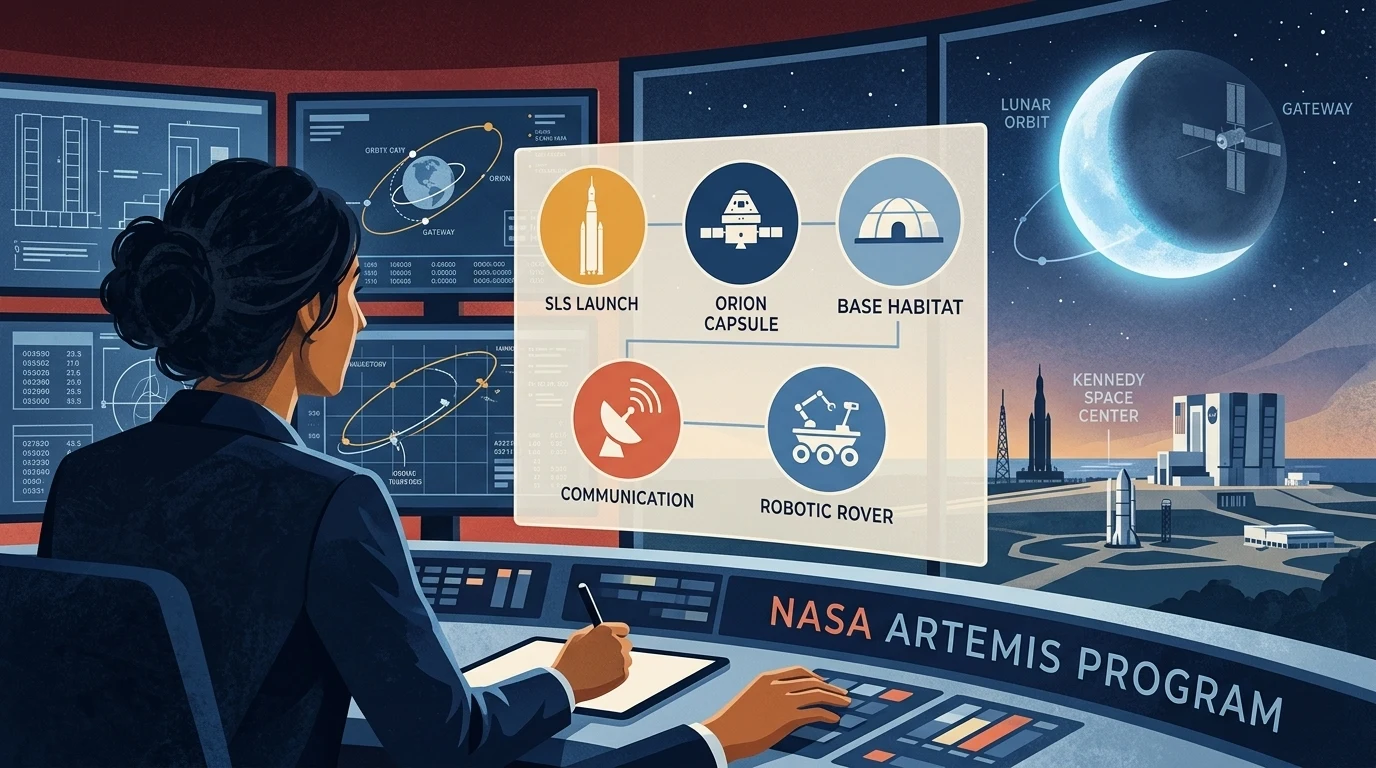
Marking an unprecedented leap forward for deep-space human exploration, the National Aeronautics and Space Administration (NASA) alongside American commercial aerospace consortiums announced the successful completion of Critical Design Reviews (CDR) for key architectural components of the Artemis Base Camp. With integrated hardware tests concluding across test facilities in Alabama, Texas, and Florida, engineers have validated the flight readiness of lunar surface power systems, unpressurized terrain transport vehicles, and the initial structural modules designed for permanent deployment at the lunar South Pole.
Unlike the historic Apollo missions of the twentieth century, which conducted short-duration exploratory sorties, the Artemis program is structured from the ground up for sustained scientific and industrial habitation. The South Pole of the Moon contains permanently shadowed craters that harbor millions of metric tons of water ice—a vital natural resource that can be extracted and electrolyzed into liquid oxygen and hydrogen rocket propellant to support onward voyages to Mars.
Surface Power Generation: Fission Surface Power and Lunar Solar Grids
A primary engineering milestone verified during the review cycle is the Fission Surface Power (FSP) system. Operating in the extreme thermal environment of the Moon, where two-week-long lunar nights plunge temperatures below minus two hundred and forty degrees Fahrenheit, solar arrays alone are insufficient to ensure continuous life-support operations. The compact, forty-kilowatt nuclear fission reactor design achieved full thermal-hydraulic validation, demonstrating automated continuous power generation without refueling for over a decade.
Complementing the nuclear reactor, aerospace teams successfully tested deployable vertical solar towers that elevate photovoltaic collectors atop high crater rims that receive near-perpetual sunlight. Connected via specialized superconducting cables, these power nodes will create an integrated microgrid supplying energy to commercial landers, autonomous rovers, and future crew habitation modules.
Surface Mobility: The Lunar Terrain Vehicle and Pressurized Habitats
Surface mobility architecture reached major milestones with the finalization of the Lunar Terrain Vehicle (LTV) contracts. Engineered to operate both as an astronaut-driven expedition rover and an autonomous robotic scout, the all-electric vehicle features specialized non-pneumatic titanium mesh wheels, radiation shielding, and autonomous terrain-mapping lidar capable of navigating treacherous crater slopes in complete darkness.
Simultaneously, structural testing on prototype inflatable habitat shells demonstrated exceptional resilience against micrometeoroid impacts and cosmic radiation exposure. By combining multi-layered Kevlar-like composite fabrics with regolith sintering—a construction technique that melts indigenous lunar soil into protective masonry blocks—engineers can shield crew quarters from long-term galactic cosmic rays without transporting heavy concrete from Earth.
International Artemis Accords and Scientific Diplomacy
The technical achievements have unfolded alongside expanding international cooperation under the Artemis Accords, which now count over forty signatory nations committed to peaceful, transparent, and sustainable lunar exploration. Global partner space agencies—including ESA, JAXA, and CSA—are delivering critical contributions, ranging from the Gateway lunar orbital station's Habitation and Logistics Outpost (HALO) to advanced robotic arm manipulators.
With upcoming crewed orbital testing slated for late 2026 and inaugural polar landings approaching, the Artemis architecture represents the convergence of government scientific vision and private commercial agility, permanently expanding humanity's economic and scientific frontier into the solar system.
How this account was assessed
This explainer is built from an attributable source set rather than anonymous aggregation. The references used for the current version are: NASA Artemis Updates and Press Releases; NASA Deep Space Exploration Architecture Review. Each source has a different evidentiary role. A public record can establish what an institution filed or announced, while independent reporting can add chronology, interviews and context. Neither should be stretched beyond what it directly supports.
What the sources can—and cannot—show
The first step is to identify the controlling fact in every paragraph: a date, action, quotation, measurement or procedural status. That fact should be traceable to a named record. Statements about motive, cause or future impact require separate evidence and should not be inferred merely because two events occurred close together. Early official information can also change. Preliminary findings, emergency statements and initial court or agency summaries should be described as preliminary until the complete record is available.
A source’s existence is not proof of every detail in a story. Readers should check whether the linked page actually contains the quoted language or number, whether it covers the same time and place and whether a newer version has replaced it. When several reports all depend on the same original statement, they count as multiple publications but only one evidentiary origin.
Reading chronology and numbers carefully
Dates should be read in three layers: when the event happened, when the information became public and when this post was last reviewed. Keeping those moments separate prevents a later update from being projected backward. Numerical claims need the same discipline. Confirm the unit, denominator, comparison period, geographic scope and whether a figure is seasonally adjusted, inflation adjusted, estimated or final. A percentage change without its starting value can exaggerate practical significance.
Independent checks for readers
Readers can reproduce the basic review by opening each reference, searching for the central names and dates and reading beyond the headline. For government or court material, find the docket, order, transcript or downloadable dataset. For company statements, compare the announcement with a filing or regulator’s record when one exists. For scientific or technical claims, prefer the underlying paper, protocol or evaluation and check whether outside specialists have examined the method.
Why this context matters
Building permanent infrastructure at the lunar South Pole enables sustained scientific exploration and deep-space missions to Mars. Authority comes from showing the path from evidence to conclusion, not from confident tone. That is why this post keeps reference links visible, states the limits of the available material and avoids treating an unresolved question as settled.
What to watch next
Artemis II crewed lunar flyby launch milestones, full-scale fission reactor prototype testing, and Gateway module integration. A useful update should name the new record, summarize the change and explain whether it confirms, narrows or contradicts the earlier account. If a correction changes a central fact, the correction should remain visible instead of being silently folded into the text.
This process does not eliminate uncertainty; it makes uncertainty legible. Readers should leave with a clear understanding of what is documented, what is attributed, what is analysis and what still requires evidence. That separation is the foundation of a durable, useful blog post.
References and further reading
Documented from official NASA engineering press briefings, contractor design review milestones, and congressional aerospace oversight reports.