

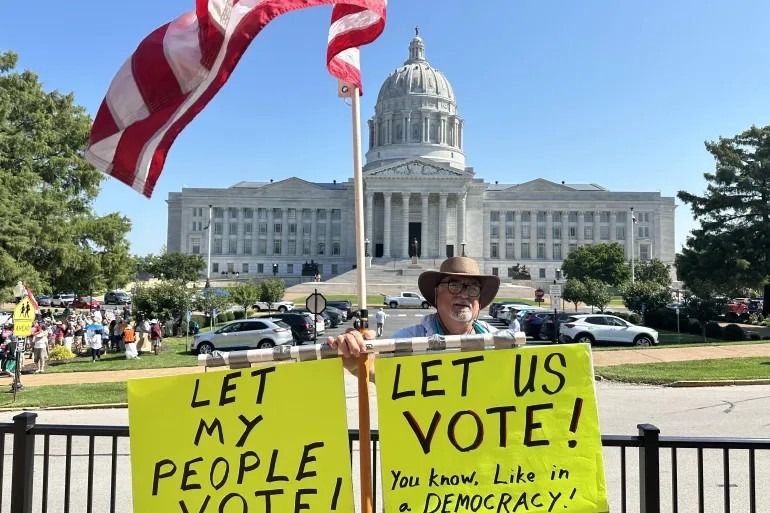
JEFFERSON CITY, Mo. — The Missouri Supreme Court has prevented a newly drawn congressional map backed by former President Donald Trump and Republican lawmakers from being used in the upcoming November 2026 elections. The decision, which was unanimous, is a blow to Republicans who had hoped that the redrawn districts would give the party an extra seat in the US House of Representatives.
The court ruled the map cannot take effect unless Missouri voters approve it in a statewide referendum. In the meantime, the state will continue to use the current congressional district lines for the general election.
Republicans who control the Missouri Legislature approved the new map as part of a nationwide effort to redraw congressional districts ahead of the midterm elections. The plan would have redrawn the lines of several districts, including that of Democratic Rep. Emanuel Cleaver, who is based in Kansas City.
GOP officials said the redistricting plan was legal and used the state’s power to draw new lines for congressional districts. But opponents argued in a citizen-led referendum effort that voters should have the opportunity to decide whether the changes should take effect.
The court’s ruling sends Missouri’s congressional districts to the voters for decision, adding yet another major legal fight to the nationwide debate over redistricting and political representation ahead of the 2026 elections.
Redistricting Fight Aims To Take Democratic Seat, Gains For Republicans
The fight is over Missouri’s 5th Congressional District, a Democratic seat in the Kansas City area. The Republican-backed map would have dramatically redrawn district lines, making it more Republican-friendly and giving the party a better chance at picking up another House seat.
Republicans had argued the new map would better reflect political changes in the state and boost their congressional strength. The proposal was part of a broader Republican strategy in several states to redraw districts ahead of the midterm elections to protect or expand their narrow House majority.
Democrats and voting rights advocates condemned the map as being drawn mainly for partisan reasons. Critics argued the change would dilute the influence of Democratic voters in Kansas City and change a district that had historically given urban communities a voice.
The legal challenge centered on whether Missouri voters had the right to challenge the congressional map through a referendum process. State officials argued that decisions about congressional redistricting were not subject to voter review, a position the state Supreme Court rejected.
The court’s ruling means the new districts drawn up can’t be used for the November general election unless they’re approved by voters, despite being used in the August primary elections. The strange situation leaves candidates who campaigned under different district lines during the primary process in limbo.
Missouri’s fight is part of a larger national battle over how congressional districts should be drawn and who gets to make those decisions.
Trump, GOP Leaders Dispute Court Ruling
The decision has sparked a political backlash from Missouri Republicans and backers of the redistricting plan. GOP officials slammed the decision, saying the court had overstepped its authority as an elected body and thrown the election process into chaos.
“Republicans will consider an appeal to the US Supreme Court,” said Missouri Attorney General Catherine Hanaway.
Party leaders warn a referendum on congressional maps could create uncertainty and make it tougher to administer elections.
The ruling is also a rebuke to Trump’s broader influence over redistricting battles. The former president and his allies had urged Republican-led states to pursue congressional map changes they thought could benefit the party ahead of the 2026 midterms.
The Missouri case is just one of many in a larger national battle over redistricting that involves both parties. States have fought over or drawn new congressional maps as Democrats and Republicans try to position themselves for advantages in future elections.
Supporters of the court’s decision said the ruling protects voters’ ability to challenge major changes to elections. They said citizens who collected hundreds of thousands of signatures for a referendum followed the state’s constitutional process and deserved a public vote.
The outcome further complicates Missouri's congressional races and could impact similar legal battles in other states where redistricting plans face public opposition or court challenges.
Voters To Decide Fate Of Missouri Congressional Map
After the court decision, the final say on the fate of the disputed congressional map likely will be in the hands of Missouri voters in a statewide referendum. The vote will decide if the Republican-backed boundaries become permanent, or if the current districts will stay in place.
Missouri will use its old congressional map for the 2026 general election until voters decide otherwise. That means Democratic Rep. Emanuel Cleaver’s district will remain intact for the November contest and the current electoral map will remain in place.
The vote could have big consequences for the balance of power in the US House. Republicans now hold a narrow majority, and winning another Missouri seat was viewed as part of their strategy to enter the midterms with a stronger hand.
The case also illustrates the growing significance of voter initiatives in shaping election laws. Missouri’s citizen-led challenge shows how referendum mechanisms can be a powerful tool to counter legislative decisions on issues such as redistricting.
Political analysts expect the Missouri vote to draw national attention because of its ties to the larger battle for control of Congress. Both sides are expected to spend big on messaging campaigns in run-up to the referendum.
The final result will decide whether Missouri will go with a map that gives Republicans more seats, or stick with the current district boundaries. The case could have ramifications beyond Missouri for future fights over who gets to draw the lines and how much power voters should have over congressional maps.