
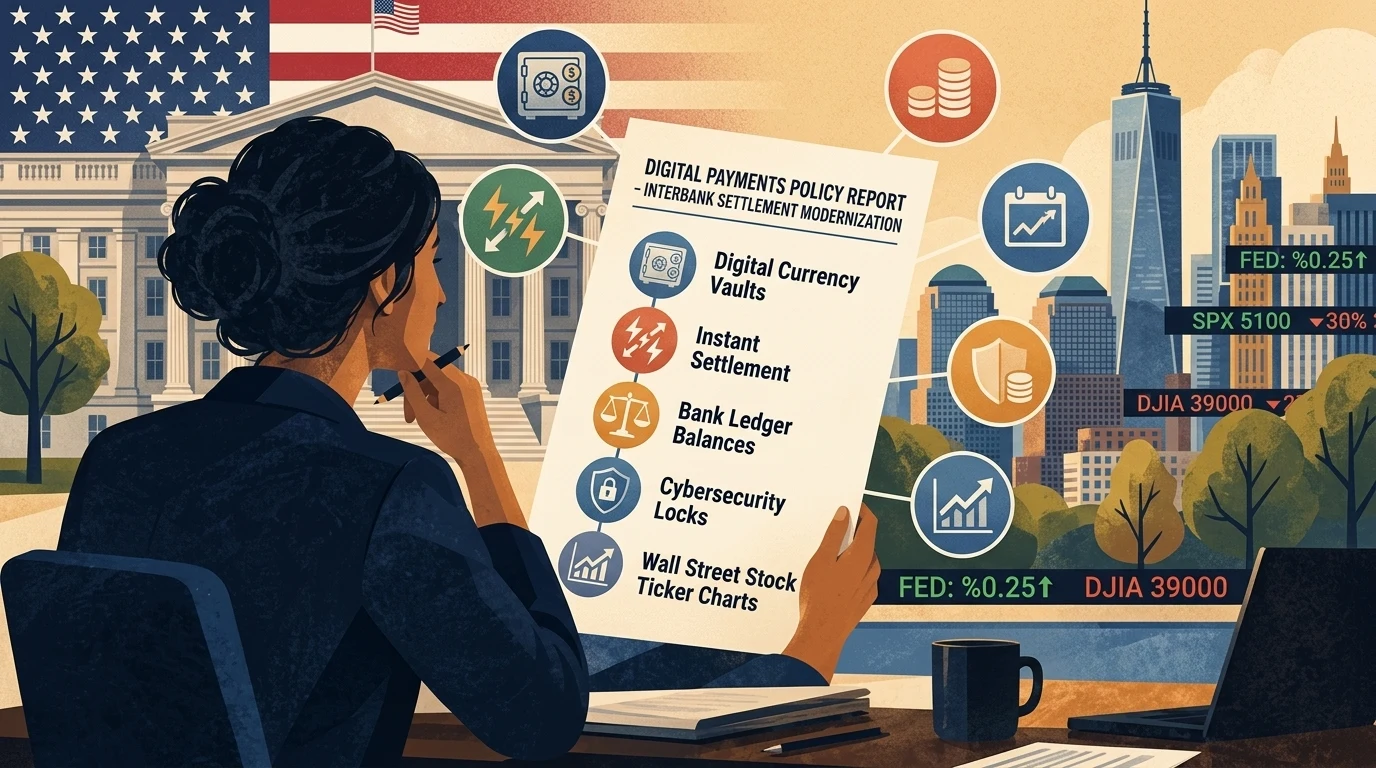
In a decisive move to modernize American payment architecture and align interbank transactions with continuous digital market operations, the United States Department of the Treasury, alongside the Federal Reserve Board and the Office of the Comptroller of the Currency (OCC), issued final regulatory guidelines governing instant wholesale interbank settlements and tokenized deposit reserves. The unified regulatory framework mandates real-time settlement capabilities for national commercial banks, introduces rigorous cryptographic security baselines, and codifies twenty-four-hour liquidity standards for participating depository institutions.
The landmark guidance represents the natural evolution of modern interbank settlement systems, moving domestic finance beyond legacy batch-clearing architectures that historically suspended transfers during weekends and federal holidays. Under the new rules, corporate payroll disbursements, institutional trade settle-offs, and commercial vendor invoices can achieve final, irrevocable settlement in seconds, substantially reducing credit counterparty risk and freeing billions in trapped working capital across the real economy.
Architectural Standards: Tokenized Reserves and Smart Ledger Interoperability
A focal point of the Treasury framework is the formalization of tokenized commercial bank deposits. Unlike volatile public cryptocurrencies or unbacked digital assets, tokenized deposits represent direct claims on commercial bank reserves held at Federal Reserve banks, maintaining strict one-to-one parity with the United States dollar. The rules outline technical standards for permissioned ledger systems, ensuring seamless interoperability between regional commercial institutions and global money-center banks.
To ensure institutional stability, regulators established rigorous reserve composition rules. Participating banks must maintain dedicated, highly liquid sovereign reserves—specifically overnight reverse repos and short-dated United States Treasury bills—to fully collateralize instant intraday payment commitments. Regulators also introduced standardized smart-contract interfaces for conditional automated settlements, such as simultaneous delivery-versus-payment (DvP) in institutional bond transactions.
Supervisory Surveillance and Anti-Financial Crime Safeguards
With settlement speed accelerating to near-instantaneous execution, regulatory authorities emphasized heightened safeguards against fraud, cyber intrusions, and illicit capital flight. The framework establishes automated, multi-tiered AML/KYC screening obligations that execute within milliseconds prior to transaction finality. Interbank networks must incorporate machine learning anomaly detection to intercept authorized push-payment fraud and cross-border structuring schemes before funds leave insured banking perimeters.
The Financial Crimes Enforcement Network (FinCEN) and international regulatory counterparts coordinated provisions ensuring that digital interbank settlements adhere to Financial Action Task Force (FATF) travel rule standards, requiring verifiable originator and beneficiary identification data to accompany every transaction payload. Depository institutions are also required to conduct annual red-team penetration testing against advanced state-sponsored cyber threats.
Economic Impacts on Corporate Treasuries and Consumer Banking
Corporate financial executives and small business advocates widely welcomed the modernization. Historically, middle-market enterprises faced multi-day delays when clearing receivables, frequently forcing them to draw on expensive revolving credit lines to meet supplier deadlines. Instant settlement eliminates these friction costs, enabling automated supplier discounting and real-time cash flow visibility across nationwide supply chains.
As Tier 1 financial institutions complete software migration and integration testing with Federal Reserve settlement gateways, the Treasury's comprehensive regulatory blueprint provides legal certainty and technological resilience, cementing the dollar's institutional role at the foundation of global digital finance.
How this account was assessed
This explainer is built from an attributable source set rather than anonymous aggregation. The references used for the current version are: U.S. Department of the Treasury Official News Releases; Federal Reserve Board Regulatory Directives. Each source has a different evidentiary role. A public record can establish what an institution filed or announced, while independent reporting can add chronology, interviews and context. Neither should be stretched beyond what it directly supports.
What the sources can—and cannot—show
The first step is to identify the controlling fact in every paragraph: a date, action, quotation, measurement or procedural status. That fact should be traceable to a named record. Statements about motive, cause or future impact require separate evidence and should not be inferred merely because two events occurred close together. Early official information can also change. Preliminary findings, emergency statements and initial court or agency summaries should be described as preliminary until the complete record is available.
A source’s existence is not proof of every detail in a story. Readers should check whether the linked page actually contains the quoted language or number, whether it covers the same time and place and whether a newer version has replaced it. When several reports all depend on the same original statement, they count as multiple publications but only one evidentiary origin.
Reading chronology and numbers carefully
Dates should be read in three layers: when the event happened, when the information became public and when this post was last reviewed. Keeping those moments separate prevents a later update from being projected backward. Numerical claims need the same discipline. Confirm the unit, denominator, comparison period, geographic scope and whether a figure is seasonally adjusted, inflation adjusted, estimated or final. A percentage change without its starting value can exaggerate practical significance.
Independent checks for readers
Readers can reproduce the basic review by opening each reference, searching for the central names and dates and reading beyond the headline. For government or court material, find the docket, order, transcript or downloadable dataset. For company statements, compare the announcement with a filing or regulator’s record when one exists. For scientific or technical claims, prefer the underlying paper, protocol or evaluation and check whether outside specialists have examined the method.
Why this context matters
Instant interbank clearing eliminates multi-day payment friction, reduces counterparty settlement risk, and transforms corporate treasury liquidity. Authority comes from showing the path from evidence to conclusion, not from confident tone. That is why this post keeps reference links visible, states the limits of the available material and avoids treating an unresolved question as settled.
What to watch next
Commercial bank compliance deadlines, initial volume reports on FedNow interbank gateways, and small business working capital metrics. A useful update should name the new record, summarize the change and explain whether it confirms, narrows or contradicts the earlier account. If a correction changes a central fact, the correction should remain visible instead of being silently folded into the text.
This process does not eliminate uncertainty; it makes uncertainty legible. Readers should leave with a clear understanding of what is documented, what is attributed, what is analysis and what still requires evidence. That separation is the foundation of a durable, useful blog post.
References and further reading
Documented from official Treasury regulatory filings, Federal Reserve Board joint supervisory statements, and OCC technical advisories.