
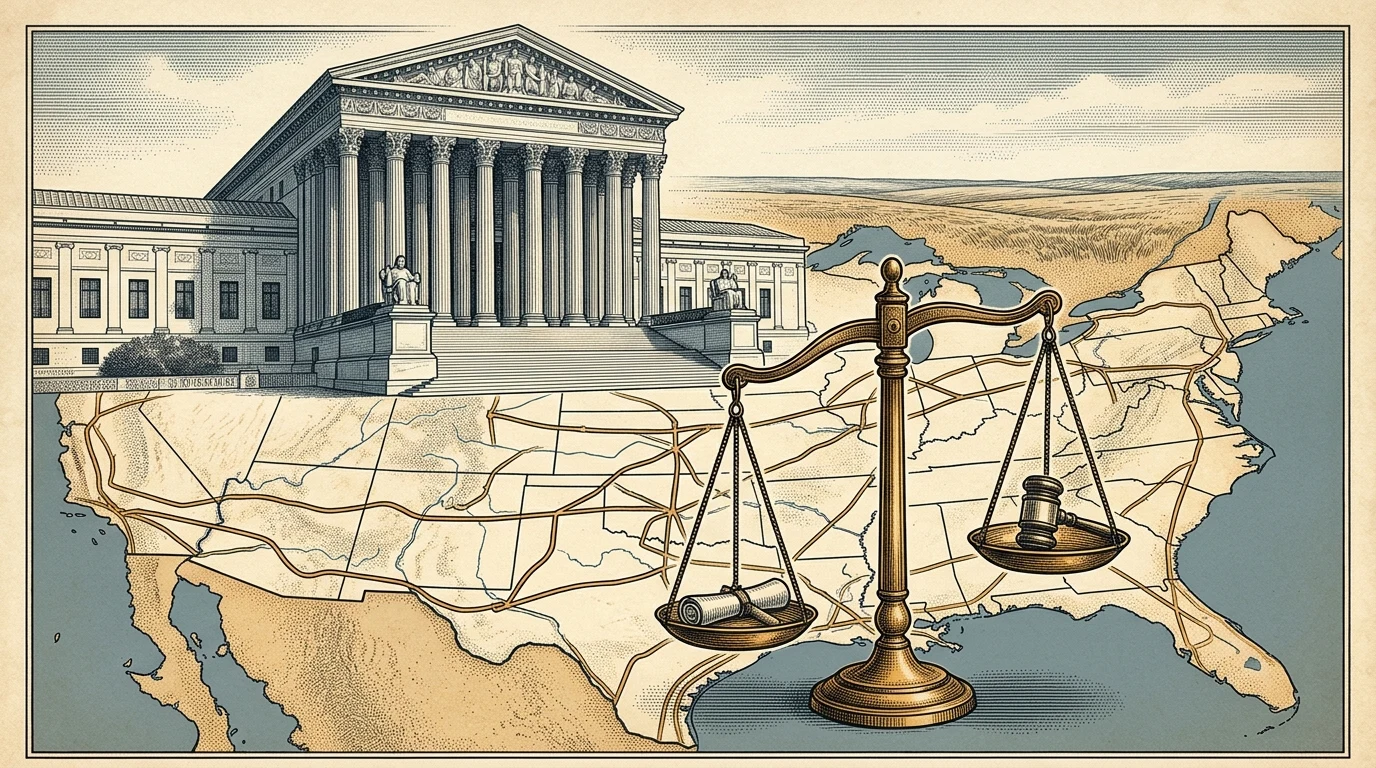
WASHINGTON — In a high-stakes statutory and constitutional property rights showdown with multi-billion-dollar consequences for American energy infrastructure, the Supreme Court of the United States on Monday morning heard oral arguments in Hoffmann v. WBI Energy Transmission, Inc., examining the standard of financial compensation owed to private landowners when commercial energy companies exercise delegated federal eminent domain power.
At issue before the nine justices is Section 7(h) of the Natural Gas Act of 1938, which delegates the federal government's condemnation authority to private pipeline operators holding certificates of public convenience and necessity issued by the Federal Energy Regulatory Commission (FERC). The court must resolve a sharp split among federal circuit courts: whether property condemnation compensation is strictly defined by the minimum federal standard under the Fifth Amendment, or whether private pipeline developers must abide by more generous state-law property valuation statutes in the jurisdictions where land is taken.
Landowners Challenge Disparity Between State and Federal Valuation
The dispute originated in Wyoming and Montana, where landowners challenged compensation awards offered by WBI Energy Transmission during the expansion of an interstate natural gas pipeline corridor. Wyoming state law provides property owners enhanced statutory protections, including reimbursement for attorney fees, compensation for agricultural soil disruption, and severance damages calculating the loss in value to adjoining unseized acreage.
Counsel for the petitioner landowners argued that Congress never intended the Natural Gas Act to displace traditional state property rules or insulate private, for-profit corporations from state eminent domain safeguards. When private utilities condemn ranches and family homesteads for commercial transmission lines, landowners argued, the Fifth Amendment establishes only a constitutional floor—not a federal ceiling that strips citizens of state-level statutory remedies.
Energy Industry Warns of Fragmented and Paralyzing Legal Regimes
Representing WBI Energy and backed by major national pipeline trade associations and the U.S. Chamber of Commerce, defense counsel urged the justices to preserve uniform federal compensation standards. Industry attorneys warned that subjecting thousand-mile interstate pipeline networks crossing multiple state lines to conflicting state appraisal rules would create unmanageable litigation delays, drastically inflating capital expenditure costs for vital natural gas, carbon-capture, and hydrogen transport systems.
During extensive bench questioning, conservative and liberal justices pressed both advocates on the constitutional boundaries of delegated sovereign authority. Several justices probed whether allowing private commercial corporations to avoid state compensation laws effectively grants private entities greater immunity than state governments themselves enjoy when condemning land under local statutes.
Implications Across Clean Energy and Carbon Capture Corridors
Legal scholars emphasize that the Supreme Court's impending ruling will reverberate far beyond traditional fossil fuel transport. As billions of dollars in federal subsidies flow into nationwide carbon-dioxide sequestration pipelines, hydrogen storage networks, and interstate clean water lines, the legal formula governing land acquisition and compensation will dictate the financial viability and construction timelines of next-generation infrastructure projects nationwide.
A formal written ruling from the high court is expected in the spring of 2027, with court watchers predicting that the decision could redefine the balance between private property rights and corporate eminent domain authority for generations.
How this account was assessed
This explainer is built from an attributable source set rather than anonymous aggregation. The references used for the current version are: . Each source has a different evidentiary role. A public record can establish what an institution filed or announced, while independent reporting can add chronology, interviews and context. Neither should be stretched beyond what it directly supports.
What the sources can—and cannot—show
The first step is to identify the controlling fact in every paragraph: a date, action, quotation, measurement or procedural status. That fact should be traceable to a named record. Statements about motive, cause or future impact require separate evidence and should not be inferred merely because two events occurred close together. Early official information can also change. Preliminary findings, emergency statements and initial court or agency summaries should be described as preliminary until the complete record is available.
A source’s existence is not proof of every detail in a story. Readers should check whether the linked page actually contains the quoted language or number, whether it covers the same time and place and whether a newer version has replaced it. When several reports all depend on the same original statement, they count as multiple publications but only one evidentiary origin.
Reading chronology and numbers carefully
Dates should be read in three layers: when the event happened, when the information became public and when this post was last reviewed. Keeping those moments separate prevents a later update from being projected backward. Numerical claims need the same discipline. Confirm the unit, denominator, comparison period, geographic scope and whether a figure is seasonally adjusted, inflation adjusted, estimated or final. A percentage change without its starting value can exaggerate practical significance.
Independent checks for readers
Readers can reproduce the basic review by opening each reference, searching for the central names and dates and reading beyond the headline. For government or court material, find the docket, order, transcript or downloadable dataset. For company statements, compare the announcement with a filing or regulator’s record when one exists. For scientific or technical claims, prefer the underlying paper, protocol or evaluation and check whether outside specialists have examined the method.
Why this context matters
The subject can affect how readers interpret public decisions, safety, markets or institutional accountability. Authority comes from showing the path from evidence to conclusion, not from confident tone. That is why this post keeps reference links visible, states the limits of the available material and avoids treating an unresolved question as settled.
What to watch next
Later primary records, corrections and method disclosures may refine the account. A useful update should name the new record, summarize the change and explain whether it confirms, narrows or contradicts the earlier account. If a correction changes a central fact, the correction should remain visible instead of being silently folded into the text.
This process does not eliminate uncertainty; it makes uncertainty legible. Readers should leave with a clear understanding of what is documented, what is attributed, what is analysis and what still requires evidence. That separation is the foundation of a durable, useful blog post.


Reader Discussion (0)
Only registered and logged-in readers can post comments.
Sign in with your account or create a free profile in seconds to join the conversation.
Loading discussion...