
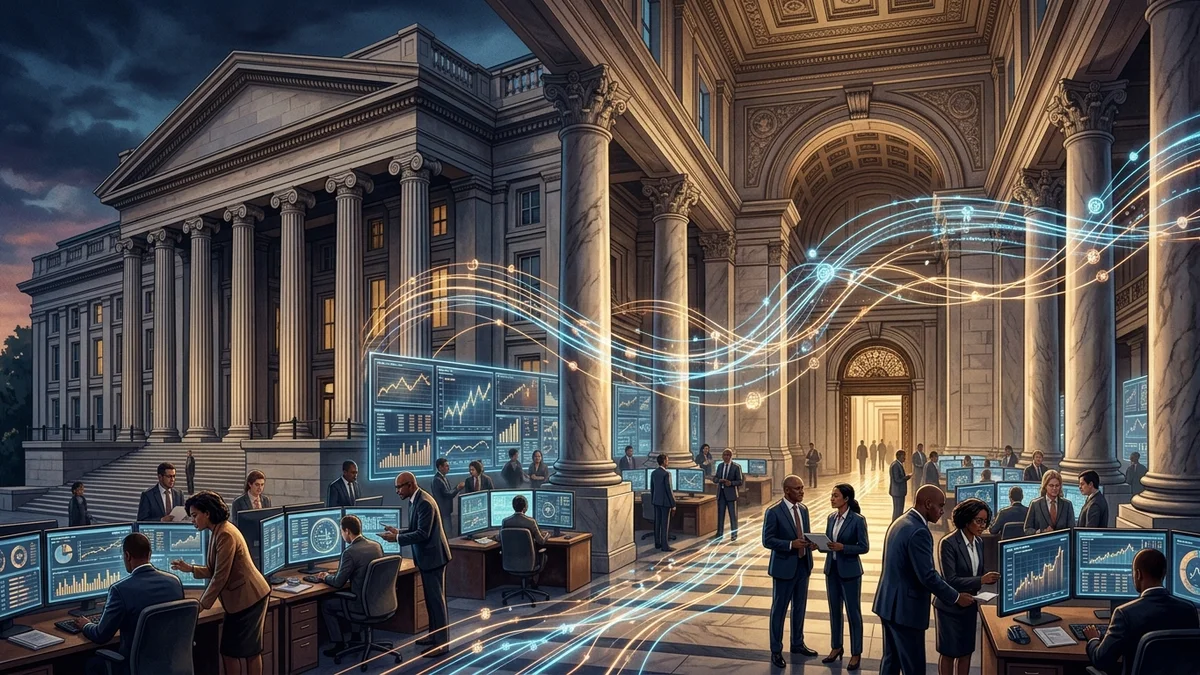
The United States Department of the Treasury, in close collaboration with the Federal Reserve Board and the Office of the Comptroller of the Currency, on Wednesday released the official technical framework for the Institutional Digital Settlement Infrastructure (IDSI). The comprehensive regulatory blueprint establishes common open-architecture protocols for commercial banks and regulated primary dealers to execute real-time, programmable settlement of wholesale deposits, sovereign debt, and cross-border commercial transactions.
Officials emphasized that the initiative is strictly focused on wholesale institutional liquidity and interbank clearance rather than a retail Central Bank Digital Currency (CBDC). By creating a shared cryptographic ledger architecture governed by existing chartered banking regulations, the Treasury aims to eliminate counterparty settlement risk, truncate clearance delays from days to seconds, and fortify American capital markets against emerging cross-border payment rivals.
Wholesale Interbank Efficiency and Liquidity Optimization
Under the current correspondent banking architecture, cross-border commercial wire transfers and institutional currency settlements traverse multiple intermediary institutions, each requiring separate bilateral credit lines, manual compliance reconciliations, and time-zone-bound clearing windows. This multi-layered structure ties up tens of billions of dollars in daily precautionary liquidity buffers across global commercial banks.
The newly established IDSI protocols enable commercial banks to tokenize insured wholesale deposits and central bank reserves on a private, permissioned cryptographic rail. Transactions are verified and finalized with atomic settlement—meaning delivery-versus-payment (DvP) and payment-versus-payment (PvP) occur simultaneously. This architectural transformation prevents the risk of failed trades during turbulent market environments and substantially lowers intraday financing costs for international trade participants.
Treasury Securities Tokenization and Collateral Velocity
A primary feature of the framework is its integration with the multi-trillion-dollar U.S. Treasury market. Primary dealer institutions will be authorized to hold and transfer tokenized representation of short-term Treasury bills, facilitating instantaneous repo lending and round-the-clock automated margin management for derivatives markets.
Securities market regulators noted that automating collateral movement will greatly enhance liquidity velocity across American financial centers. In times of sudden market volatility, clearinghouses will be able to verify and settle margin requirements instantaneously, avoiding the liquidity crunches that characterized historical credit panics.
Cybersecurity Standards and Privacy Guarantees
Addressing technological and privacy concerns raised during the public comment period, Treasury officials detailed the multi-layered defensive posture embedded within the IDSI architecture. The protocol integrates post-quantum cryptographic encryption standards developed in partnership with the National Institute of Standards and Technology (NIST), ensuring long-term resilience against computational decryption attacks.
Furthermore, the framework explicitly prohibits federal surveillance of institutional or corporate transaction details, leaving customer account privacy and Bank Secrecy Act / Anti-Money Laundering (BSA/AML) compliance within the domain of individual regulated depository institutions. Major financial trade consortiums responded favorably to the rollout, signaling that pilot institutional clearance runs will begin during the first quarter of 2027.
References and further reading
Documented against the Treasury Department's published Technical Blueprint on Wholesale Interbank Settlement Modernization.


