
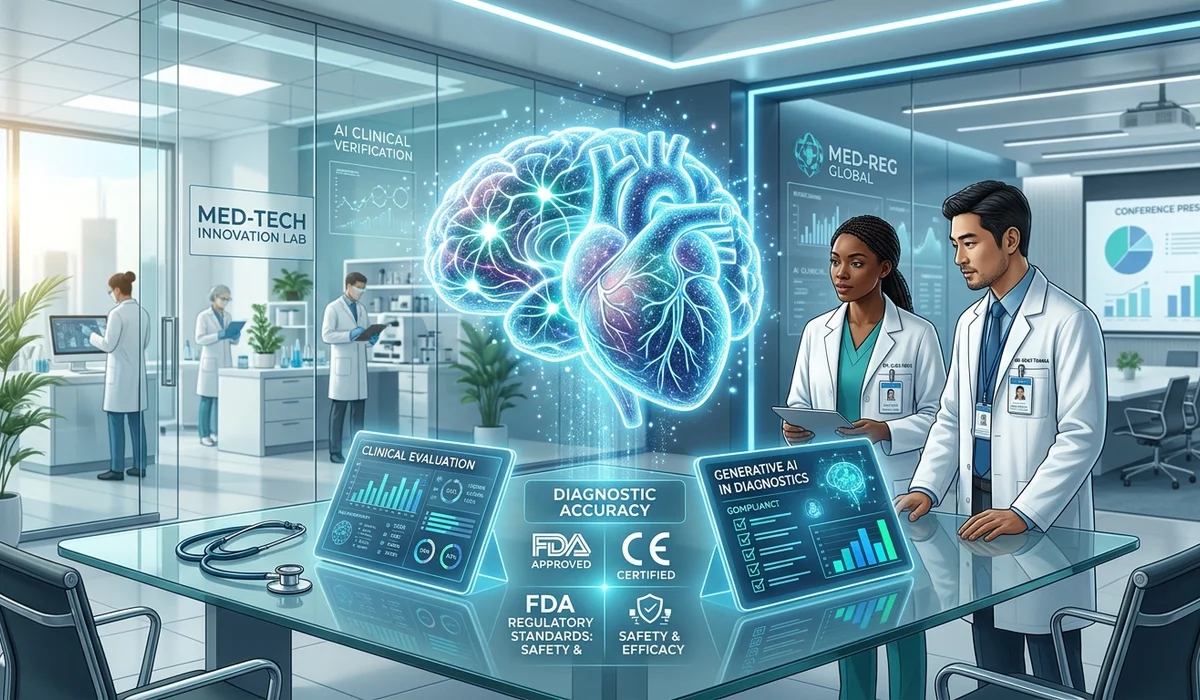
SILVER SPRING, Md. — Confronting one of the most transformative yet perilous frontiers in modern medicine, the U.S. Food and Drug Administration’s Digital Health Advisory Committee convened on Wednesday for a pivotal two-day public hearing to formulate federal regulatory standards for generative artificial intelligence and large language models integrated into clinical healthcare devices.
The meeting marked the inaugural major assembly of the agency's newly formed Digital Health Advisory Committee, bringing together leading biostatisticians, academic medical researchers, hospital system chief information officers, patient advocacy representatives, and software executives. The central challenge before the panel: how the world’s gold-standard medical regulator can evaluate, clear, and continuously monitor non-deterministic generative models that constantly evolve, synthesize natural language, and possess inherent risks of diagnostic "hallucination."
While the FDA has previously authorized more than 900 AI- and machine learning-enabled medical devices, nearly all of those cleared technologies rely on "locked," deterministic algorithms—such as narrow computer-vision models trained specifically to identify pulmonary nodules on CT scans or detect diabetic retinopathy in fundus photography. Generative AI, by contrast, operates probabilistically, generating novel clinical summaries, drafting complex treatment recommendations, and conversing directly with patients and providers.
"Generative AI represents a quantum leap beyond traditional medical software," stated Dr. Troy Tazbaz, director of the FDA’s Digital Health Center of Excellence, during his opening address. "Because these models generate novel outputs from complex multimodal inputs, our regulatory frameworks must evolve from static point-in-time premarket reviews to continuous, total-lifecycle governance models that monitor real-world performance at the bedside."
Addressing Hallucinations, Algorithmic Bias, and Diagnostic Drift
Throughout the extensive expert testimony, committee members zeroed in on three paramount clinical safety hazards: algorithmic hallucination (where a model confidently invents non-existent lab results or medical contraindications), demographic bias (where training data lacks equitable representation across racial and socioeconomic cohorts), and "diagnostic drift" (where model efficacy deteriorates as hospital patient populations or diagnostic nomenclatures shift over time).
Committee panelists debated proposed Total Product Lifecycle (TPLC) regulatory mandates. Among the central proposals discussed was requiring medical device manufacturers to implement continuous automated drift-detection telemetry that would trigger mandatory recalibration or safety freezes if error rates breach strict predetermined confidence thresholds.
Experts also emphasized the critical necessity of "Human-in-the-Loop" (HITL) architectural constraints, recommending that high-risk generative diagnostic software be legally restricted to secondary decision-support roles requiring affirmative sign-off from licensed physicians before any clinical intervention, medication dosage, or surgical plan can be initiated.
Balancing Patient Protection with American Innovation
Industry representatives from major digital health and enterprise AI developers urged federal regulators to adopt risk-calibrated, agile frameworks rather than burdensome premarket testing cycles that could delay lifesaving technology. They pointed to compelling hospital pilot studies demonstrating that generative AI clinical documentation tools reduce physician administrative burnout by up to two hours per shift and assist overwhelmed emergency department triage staff in rapidly surfacing critical lab anomalies.
However, patient safety organizations cautioned that hospitals cannot become uncontrolled testing grounds for commercial software. They called for mandatory algorithmic transparency registries requiring device developers to publicly disclose training data demographics, model parameter architectures, and formal clinical trial error distributions.
The advisory committee will synthesize its formal consensus recommendations into a technical guidance white paper for FDA leadership, which will serve as the evidentiary blueprint for forthcoming FDA draft regulatory guidance on Generative AI-Enabled Medical Devices slated for public comment in early 2025.
How this account was assessed
This report is compiled from public proceedings, technical briefing documents, and live transcript records of the FDA Digital Health Advisory Committee Meeting held on November 20–21, 2024. Expert statements and regulatory proposals reflect the official docket materials submitted under FDA Docket No. FDA-2024-N-3850.
Independent checks for readers
Readers and healthcare professionals can review the meeting agenda, public presentations, committee rosters, and submitted public comments on the official FDA Digital Health Advisory Committee portal at fda.gov. Background documentation on previously cleared AI/ML-enabled devices is maintained in the FDA's searchable medical device database.




Reader Discussion (0)
Only registered and logged-in readers can post comments.
Sign in with your account or create a free profile in seconds to join the conversation.
Loading discussion...