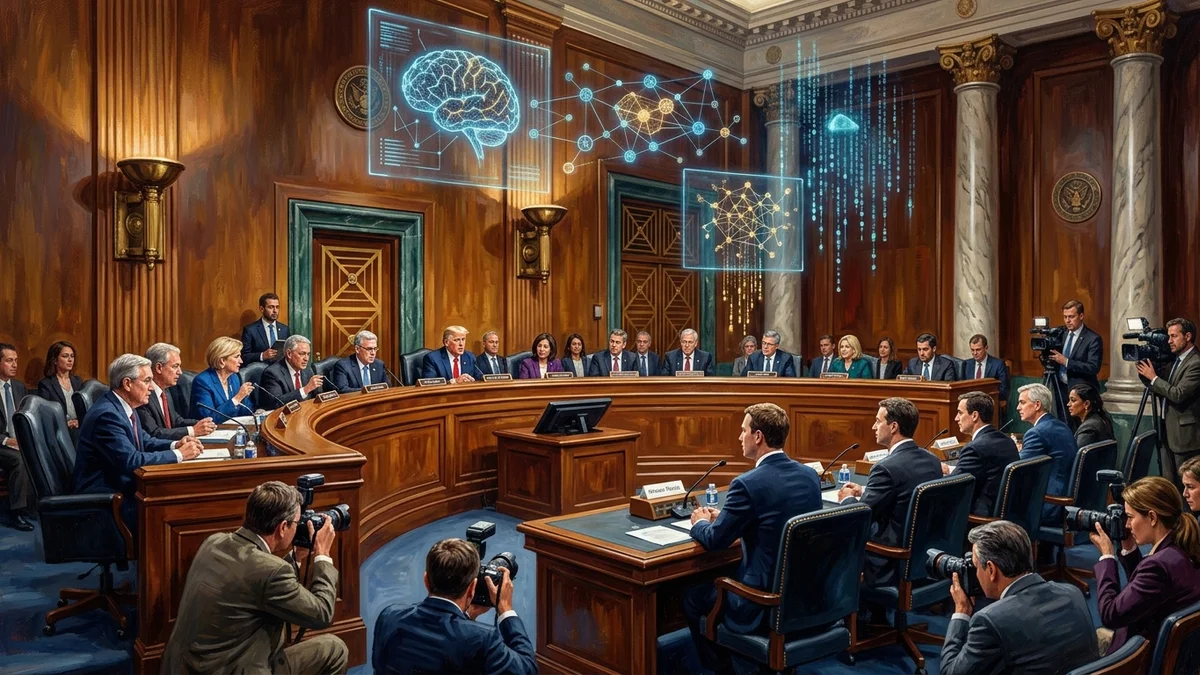
In an overwhelming display of cross-party consensus on national security and technological risk, the United States Senate on Thursday approved the National Defense Artificial Intelligence Governance and Assurance Accord by an 88-to-9 vote. The historic legislation establishes the nation's first binding statutory guardrails governing how military agencies, intelligence bureaus, and defense contractors may develop, train, and deploy autonomous algorithm models in combat and intelligence operations.
Crafted through joint deliberations across the Senate Armed Services, Intelligence, and Commerce Committees, the measure addresses mounting apprehension from defense strategists, technologists, and civil liberties organizations over the rapid fielding of autonomous decision-making systems. Lawmakers sought to strike a delicate equilibrium: ensuring the United States maintains its technological edge against strategic adversaries while guaranteeing that critical kinetic decisions remain under immutable human oversight.
Statutory Human-in-the-Loop Mandates and Safety Firewalls
The cornerstone of the newly passed legislation is an absolute statutory prohibition against fully autonomous kinetic strike systems. Under Title II of the accord, any algorithmic platform tasked with target identification, threat prioritization, or engagement execution must require verified, non-bypassable human authorization at the decisive stage of weapon release. The law classifies any deliberate attempt by contractors or military personnel to circumvent human verification protocols as a severe federal offense carrying criminal penalties.
Furthermore, the bill directs the Department of Defense to create the National Defense Model Evaluation Office, an independent operational testing authority empowered to conduct red-teaming, adversarial stress tests, and algorithmic bias audits before any model enters procurement pipelines. Models exhibiting unpredictable emergent behaviors, hallucinations in degraded operational environments, or susceptibility to prompt-injection spoofing will be barred from deployment across frontline command networks.
Coordinated Supply Chain Security and Export Controls
Beyond battlefield protocols, the accord introduces aggressive supply chain security requirements targeting advanced computing hardware and foundation model weights. The legislation directs the Bureau of Industry and Security, in coordination with the National Security Council, to establish unified export restrictions preventing adversarial nation-states from acquiring high-bandwidth memory chips, specialized neural processing units, and proprietary training datasets used in defense-grade AI.
Defense contractors receiving federal funds will also be required to maintain zero-trust provenance logs detailing the source of all training data, third-party software libraries, and fine-tuning parameters. Lawmakers pointed to recent cyber-intrusions where commercial neural models were poisoned with stealth backdoors as clear evidence that algorithmic integrity must be defended with the same rigor as physical weapons arsenals.
Bipartisan Support and Executive Implementation
Floor debate highlighted rare ideological harmony between defense hawks and civil libertarians, who both praised the framework for preempting catastrophic technological miscalculations. Senate committee leaders emphasized that setting clear, unambiguous legal baselines provides American aerospace and technology defense contractors with the regulatory certainty required to invest billions in reliable, auditable engineering.
The White House announced that the President intends to sign the measure into law immediately upon receipt of the reconciled text from the House of Representatives, calling the bill an indispensable foundation for 21st-century deterrence and sovereign technological responsibility.
References and further reading
Documented against the formal legislative text of the National Defense AI Governance Accord.