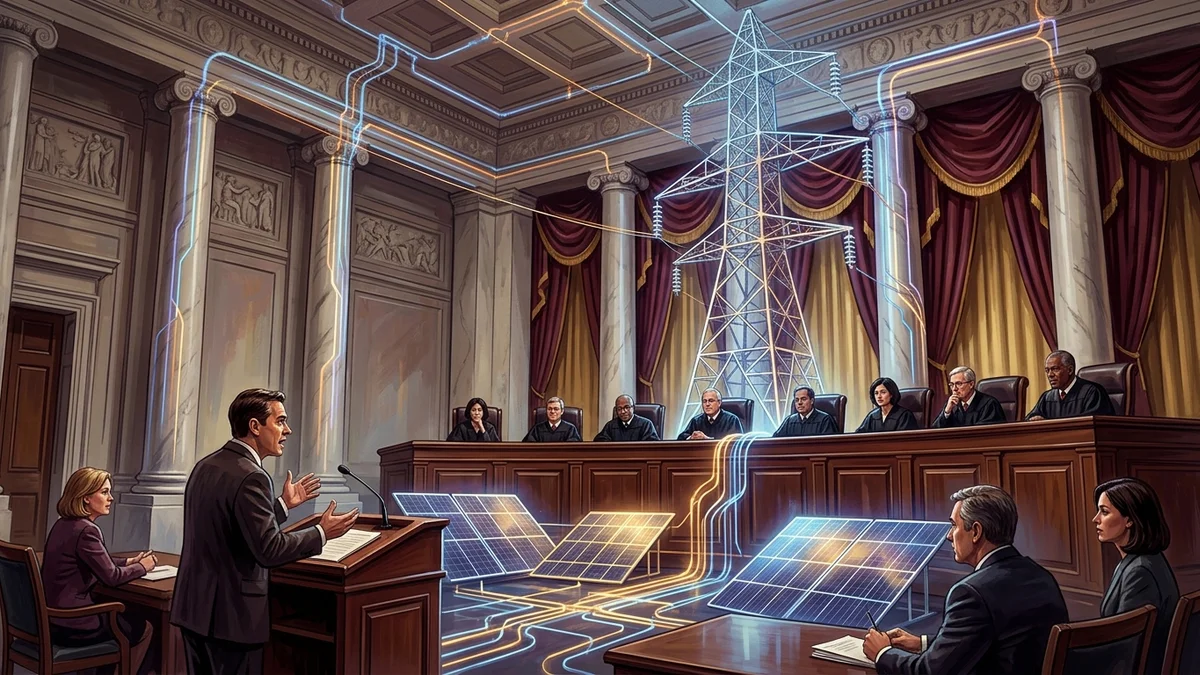
The Supreme Court of the United States on Tuesday heard more than two hours of rigorous oral argument in a landmark dispute that could redefine the division of authority between federal energy regulators and state utility commissions. At issue is whether the Federal Energy Regulatory Commission (FERC) possesses the statutory authority under the Federal Power Act to mandate cost allocation and fast-track approvals for regional interstate transmission lines that cross state lines without unanimous state consent.
The case, captioned Consolidated Utilities Alliance v. Federal Energy Regulatory Commission, arrived at the court following divergent circuit court opinions regarding the scope of federal transmission planning rules. With billions of dollars in planned offshore wind, solar arrays, and next-generation nuclear interconnects waiting in regional planning queues, the justices’ eventual ruling will profoundly influence the pace of the nationwide energy transition.
Federal Interconnection Mandates vs. State Siting Sovereignty
During arguments, attorneys representing a coalition of nineteen state attorneys general contended that the federal government is attempting an unprecedented encroachment upon traditional state police powers. Siting electrical transmission towers, evaluating local environmental impacts, and assessing retail ratepayer burden have historically rested squarely within the sovereign purview of state public service commissions. State advocates warned that granting federal regulators unilateral power to apportion interstate project costs onto unwilling local consumers violates the fundamental statutory balance struck by Congress in 1935.
Conversely, counsel for the Solicitor General and independent grid operators argued that the modern electrical grid operates as an interconnected national machine where bottlenecks in one state jeopardize grid resilience across entire regional economic hubs. Federal advocates highlighted that prolonged state-level permitting delays and local NIMBY disputes have prevented modern utility-scale energy projects from delivering lower-cost, clean wholesale power to growing metropolitan industrial centers.
The Justices Probe Statutory Text and Practical Remedies
The questioning from the bench cut across ideological lines, with justices closely scrutinizing the explicit text of Section 201 of the Federal Power Act. Several conservative justices pressed the government on whether its broad interpretation of 'practices affecting wholesale rates' would effectively swallow all local retail regulation, invoking the major questions doctrine to question whether Congress intended to grant such expansive transmission preemption without clearer legislative direction.
At the same time, moderate and liberal members of the court probed utility industry representatives on the national security implications of an increasingly fragmented electrical infrastructure. Questions highlighted the vulnerability of regional power grids to severe weather anomalies and sudden demand spikes driven by automated artificial intelligence datacenters, asking whether states could legally blockade transmission lines essential for safeguarding multi-state energy security.
Implications for Clean Energy Investment and Infrastructure
Market analysts and energy economists following the proceedings noted that capital markets require immediate regulatory clarity. Over three hundred gigawatts of renewable generation projects are currently stalled in transmission interconnection studies across the Midwest, Mid-Atlantic, and Western power pools.
A decision affirming federal preemption would dramatically accelerate high-voltage direct-current transmission builds and unlock private capital for clean power corridors. A ruling curtailing federal authority, by contrast, will place the onus back onto Congress to negotiate explicit statutory permitting reform. A final written opinion in the case is expected before the conclusion of the court's current term in late spring.
References and further reading
Documented against the published argument transcript of Consolidated Utilities Alliance v. FERC (Docket No. 25-1104).