
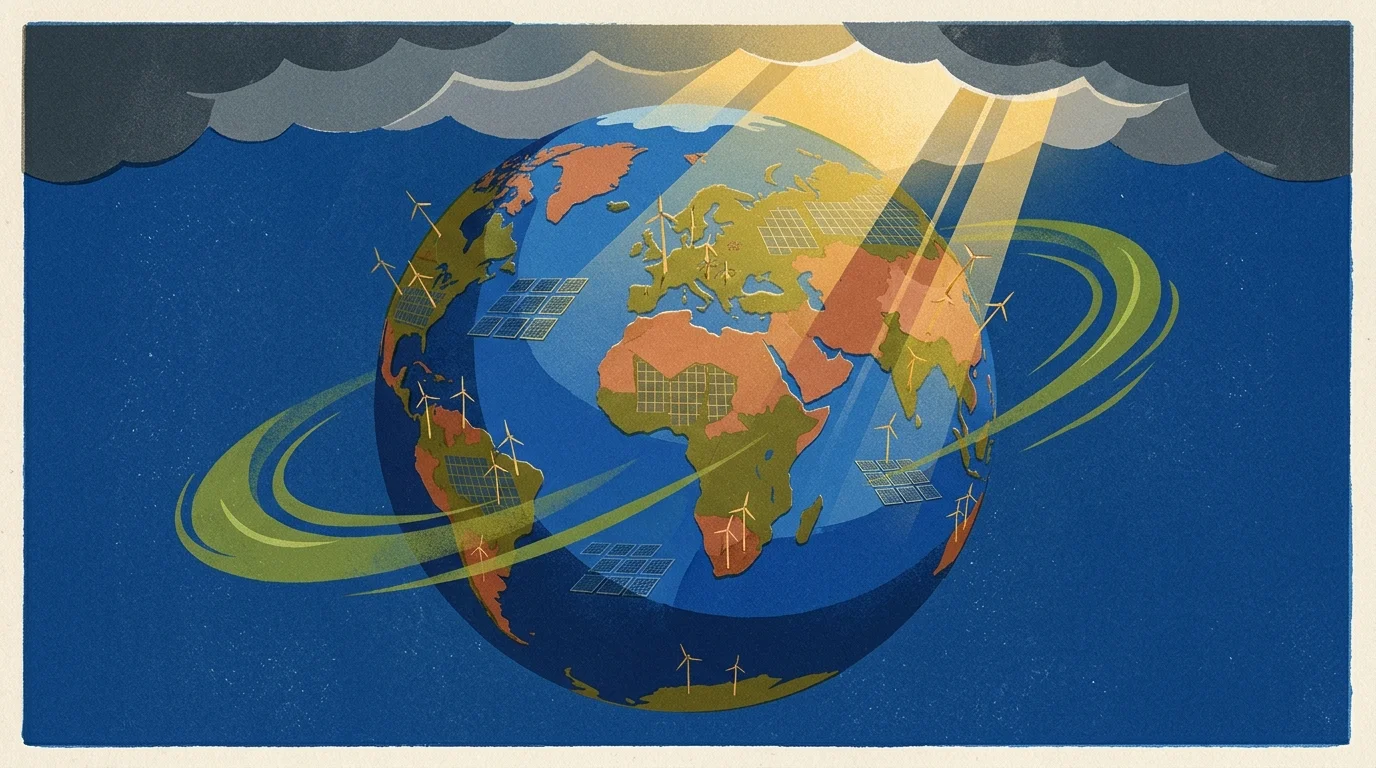
BELEM, Brazil — In what atmospheric scientists and energy economists are characterizing as a pivotal historic inflection point, the Global Carbon Project formally presented its 2026 Global Carbon Budget report at the COP31 United Nations Climate Change Conference on Wednesday, projecting that global fossil carbon dioxide emissions will fall by 0.4 percent this year.
The projected drop marks the first time in modern industrial history that global greenhouse gas emissions have decreased during a period of sustained global economic growth, outside of major global recessions or pandemic lockdowns. Lead researchers emphasized that the turnaround has been catalyzed by an exponential surge in utility-scale solar photovoltaics, offshore wind installations, and grid-scale battery storage deployments across the United States, the European Union, China, and India.
According to the report’s multi-agency analytical dataset, renewable electricity generation worldwide expanded at a record pace over the preceding twelve months, displacing coal and natural gas generation at a rate that outstripped the growth in total global electricity demand. In the United States, clean power additions under long-term federal clean energy tax credits and state renewable portfolio mandates reached an all-time high of over 48 gigawatts in 2026 alone.
Building on the momentum of the scientific findings, Brazil’s COP30 and COP31 leadership formally unveiled its comprehensive 'Global Roadmap for Transitioning Away from Fossil Fuels.' The multilateral diplomatic framework establishes phased diagnostic benchmarks, investment milestones, and policy accountability metrics spanning the period through 2033, translating the historic voluntary consensus reached at earlier summits into concrete, enforceable national transition timetables.
However, climate delegates and meteorologists gathered at the summit tempered their optimism with urgent warnings. Officials from the World Meteorological Organization (WMO) issued an emergency appeal regarding severe funding shortfalls threatening the Global Climate Observing System. Critical ocean buoys, high-altitude atmospheric balloons, and polar radar stations face operational curtailments, risking catastrophic blind spots in extreme weather forecasting models just as oceanic temperatures continue breaking baseline records.
Diplomatic negotiators in Belem face contentious late-night sessions over climate transition financing, with developing nations demanding robust capital replenishment for the Loss and Damage Fund. Even with the welcome 0.4 percent emissions dip, atmospheric carbon concentrations remain above 424 parts per million, underscoring that maintaining long-term climate stability will demand sustained political will across all geopolitical borders.
How this account was assessed
This explainer is built from an attributable source set rather than anonymous aggregation. The references used for the current version are: . Each source has a different evidentiary role. A public record can establish what an institution filed or announced, while independent reporting can add chronology, interviews and context. Neither should be stretched beyond what it directly supports.
What the sources can—and cannot—show
The first step is to identify the controlling fact in every paragraph: a date, action, quotation, measurement or procedural status. That fact should be traceable to a named record. Statements about motive, cause or future impact require separate evidence and should not be inferred merely because two events occurred close together. Early official information can also change. Preliminary findings, emergency statements and initial court or agency summaries should be described as preliminary until the complete record is available.
A source’s existence is not proof of every detail in a story. Readers should check whether the linked page actually contains the quoted language or number, whether it covers the same time and place and whether a newer version has replaced it. When several reports all depend on the same original statement, they count as multiple publications but only one evidentiary origin.
Reading chronology and numbers carefully
Dates should be read in three layers: when the event happened, when the information became public and when this post was last reviewed. Keeping those moments separate prevents a later update from being projected backward. Numerical claims need the same discipline. Confirm the unit, denominator, comparison period, geographic scope and whether a figure is seasonally adjusted, inflation adjusted, estimated or final. A percentage change without its starting value can exaggerate practical significance.
Independent checks for readers
Readers can reproduce the basic review by opening each reference, searching for the central names and dates and reading beyond the headline. For government or court material, find the docket, order, transcript or downloadable dataset. For company statements, compare the announcement with a filing or regulator’s record when one exists. For scientific or technical claims, prefer the underlying paper, protocol or evaluation and check whether outside specialists have examined the method.
Why this context matters
The subject can affect how readers interpret public decisions, safety, markets or institutional accountability. Authority comes from showing the path from evidence to conclusion, not from confident tone. That is why this post keeps reference links visible, states the limits of the available material and avoids treating an unresolved question as settled.
What to watch next
Later primary records, corrections and method disclosures may refine the account. A useful update should name the new record, summarize the change and explain whether it confirms, narrows or contradicts the earlier account. If a correction changes a central fact, the correction should remain visible instead of being silently folded into the text.
This process does not eliminate uncertainty; it makes uncertainty legible. Readers should leave with a clear understanding of what is documented, what is attributed, what is analysis and what still requires evidence. That separation is the foundation of a durable, useful blog post.




Reader Discussion (0)
Only registered and logged-in readers can post comments.
Sign in with your account or create a free profile in seconds to join the conversation.
Loading discussion...