
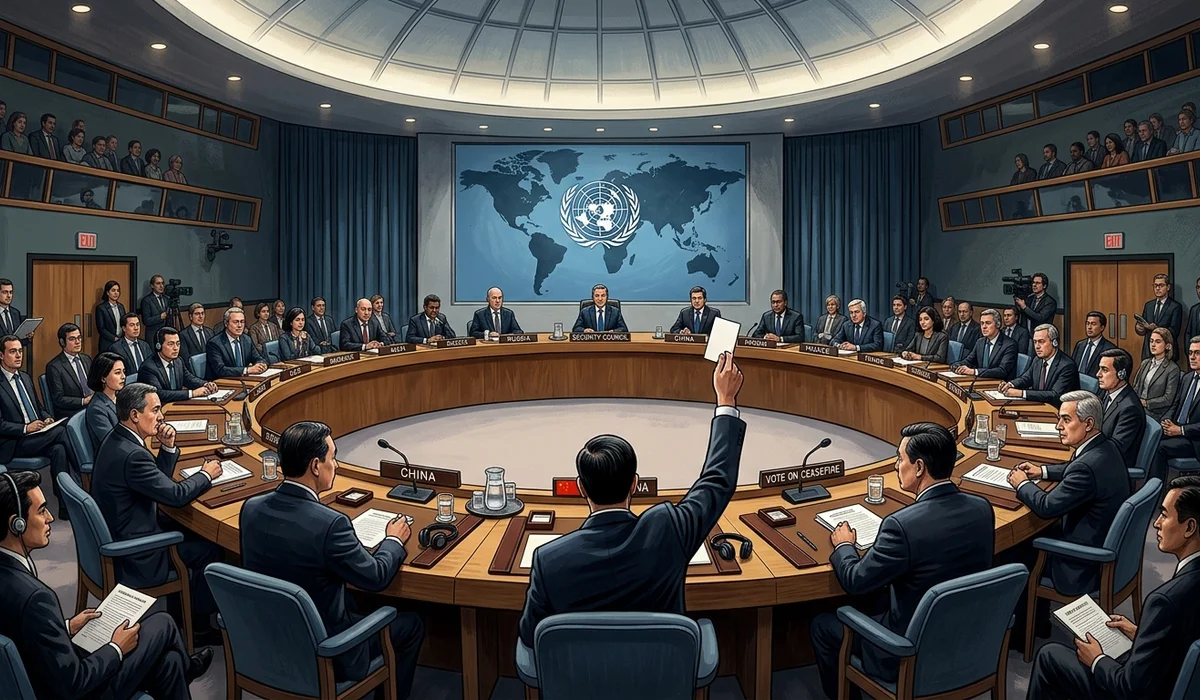
UNITED NATIONS — The United States stood isolated in the United Nations Security Council on Wednesday as it cast its sole veto to block a resolution calling for an immediate, unconditional, and permanent ceasefire in the Gaza Strip, asserting that the diplomatic measure would dangerously reward Hamas and abandon remaining hostages.
The draft resolution, sponsored by the ten non-permanent elected members of the Security Council (E10) led by Algeria, received fourteen votes in favor from the remaining council members, including traditional American allies France, the United Kingdom, Japan, and South Korea. However, the lone negative vote cast by the United States—as one of the five permanent veto-wielding members—effectively defeated the measure under UN Charter rules.
Addressing the council chamber immediately following the vote, Deputy U.S. Representative to the UN Robert Wood articulated Washington’s redline, stating that the United States had engaged in weeks of negotiations to craft a compromise that inextricably linked any cessation of hostilities to the unconditional liberation of all captives.
"We made clear throughout negotiations we could not support an unconditional ceasefire that failed to release the hostages," Ambassador Wood declared. "For us, it must be an enduring end to the war with the release of the hostages. These two urgent goals are inextricably linked. This resolution abandoned that necessity, and for that reason, the United States could not support it."
Diplomatic Fractures and International Reaction
The vote exposed deep, enduring geopolitical fault lines within the world’s preeminent international security body. Representatives of Arab nations and European partners expressed profound dismay, noting that more than 44,000 Palestinians have been killed in the conflict and that severe famine and humanitarian collapse are devastating northern Gaza amidst Israeli military encirclement.
Algeria's UN Ambassador Amar Bendjama lamented that the council’s inaction demonstrated a tragic failure to uphold its core charter responsibility to protect civilian lives. "Today’s message is clear to the Palestinian people: while the overwhelming majority of the world stands in solidarity with your plight, regrettably, others remain indifferent to your suffering," Bendjama told the council.
Conversely, Israel’s Ambassador to the UN Danny Danon praised the American veto, labeling the defeated resolution a "betrayal" that would have legitimized terrorism. Danon asserted that an unconditional ceasefire without hostage liberation would have effectively granted Hamas immunity to regroup, rearm, and perpetuate future atrocities.
Humanitarian Stalemate and U.S. Leverage
The American veto marked the fourth time since the outbreak of hostilities in October 2023 that Washington has shielded Israel from binding Security Council ceasefire resolutions. While the Biden administration has intensified bilateral diplomatic pressure on Israeli Prime Minister Benjamin Netanyahu’s cabinet—issuing a joint State and Defense Department memorandum demanding dramatic surges in humanitarian aid convoys—the administration has consistently resisted multilateral mandates that it believes undermine direct mediation conducted alongside Qatar and Egypt.
Diplomats noted that the draft resolution also contained provisions demanding the immediate, unhindered delivery of basic humanitarian assistance across all of Gaza, the protection of civilians and medical facilities under international humanitarian law, and the strict adherence to UN Security Council Resolution 2735, which had outlined a three-phase hostage-for-ceasefire framework.
How this account was assessed
This report is synthesized from official verbatim records of the 9790th meeting of the United Nations Security Council (S/PV.9790), the complete draft text of document S/2024/835, official explanatory statements delivered by participating diplomatic delegations, and briefings by the UN Office for the Coordination of Humanitarian Affairs (OCHA).
Independent checks for readers
Readers can review the verbatim meeting transcripts, voting tallies, and draft text directly through the UN Digital Library and the UN Meetings Coverage and Press Releases repository at press.un.org. Background documentation on resolution sponsorship and voting procedures is maintained by the Security Council Report research group.



Reader Discussion (0)
Only registered and logged-in readers can post comments.
Sign in with your account or create a free profile in seconds to join the conversation.
Loading discussion...