
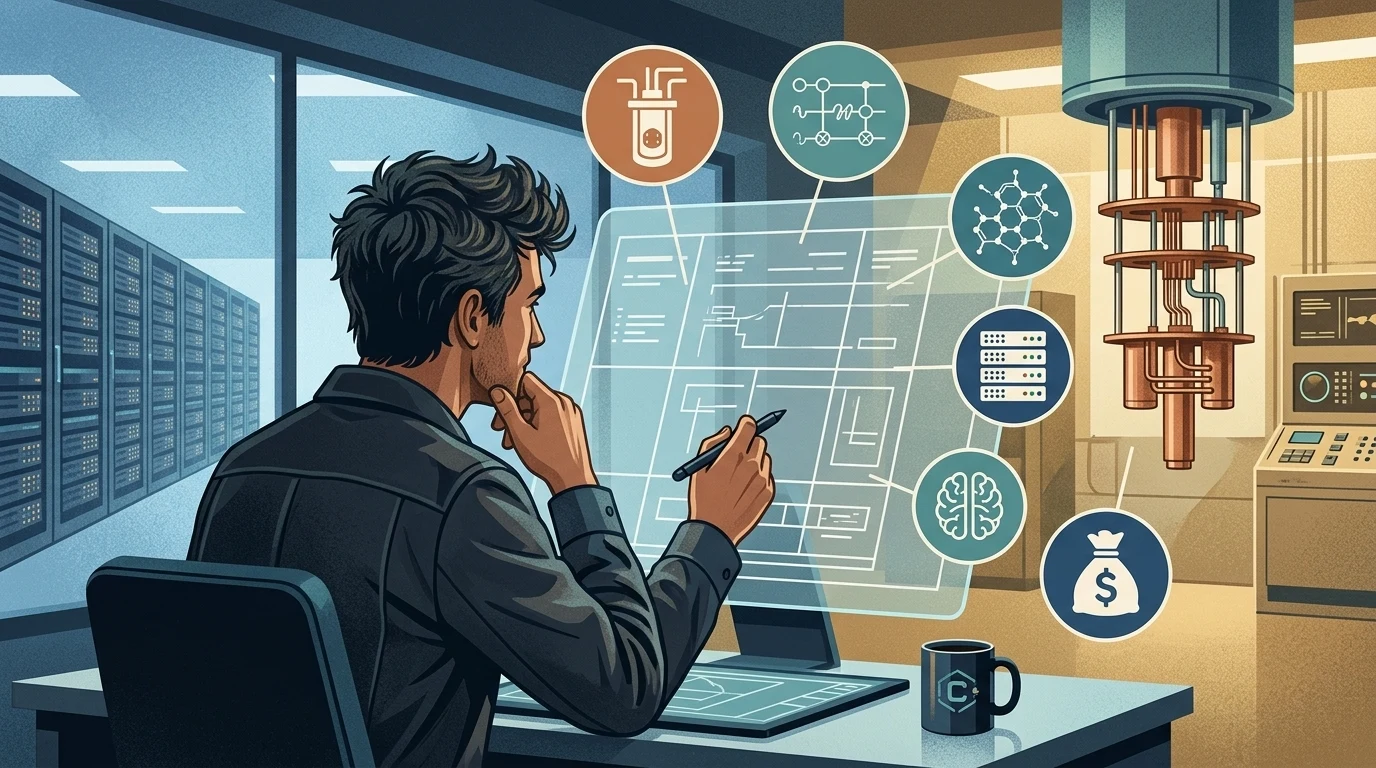
In what computer scientists and industrial physicists are characterizing as a decisive turning point for commercial quantum computing, an alliance of leading United States technology corporations and Department of Energy national laboratories has announced the operational deployment of a fully integrated hybrid quantum-classical supercomputing architecture. Located at a state-of-the-art facility in the Pacific Northwest, the platform successfully bridged logical, error-mitigated quantum processors with petascale GPU-accelerated computing nodes to execute complex pharmaceutical synthesis calculations that were previously insoluble through classical algorithms alone.
The breakthrough centers on real-time cryogenic interconnects and low-latency optical links that allow traditional supercomputers to orchestrate quantum algorithms without suffering decoherence bottlenecks. By utilizing advanced quantum error correction codes running across hundreds of physical superconducting qubits, the team sustained stable logical qubit operations for extended runtimes, delivering reproducible results with fidelity benchmarks exceeding ninety-nine point nine percent.
Bridging Theoretical Physics and Industrial Utility
For decades, quantum computing resided predominantly in experimental physics laboratories, constrained by environmental thermal noise, brief quantum coherence windows, and high physical error rates. The newly demonstrated hybrid architecture circumvents these constraints by distributing computational workloads according to mathematical architecture. Classical GPU superclusters handle data preprocessing, boundary parameter definitions, and non-quantum matrix calculations, while delegating highly correlated molecular orbital calculations and quantum Hamiltonian simulations to the quantum processing unit (QPU).
The initial benchmark application simulated the chemical catalysis of nitrogen-fixing enzymes at the atomic level, an organic process essential for next-generation agricultural fertilizer synthesis that currently consumes over one percent of global natural gas output. Classical supercomputers require months of approximation to model such electron interactions; the hybrid system produced high-accuracy electronic ground-state approximations within hours, verifying theoretical predictions with laboratory validation.
Commercial Implications for Healthcare, Materials, and Cybersecurity
Corporate research partners across biotechnology, aerospace engineering, and specialty chemicals are already booking computational allocations on the cloud-accessible hybrid system. Pharmaceutical developers intend to leverage the cluster to model protein folding and targeted small-molecule binding dynamics, significantly compressing the preclinical drug discovery timeline from years into weeks. In materials science, researchers are targeting the design of room-temperature solid-state electrolyte compositions for long-range electric aviation batteries.
The milestone has simultaneously heightened urgency surrounding cryptographic infrastructure transitions. As quantum processors demonstrate reproducible fault-tolerant scaling pathways, government cybersecurity agencies and financial institutions are accelerating the deployment of post-quantum cryptographic (PQC) encryption algorithms approved by NIST. The White House Office of Science and Technology Policy reiterated that all critical federal information systems must complete post-quantum migration by 2030 to guard against harvest-now, decrypt-later threats.
National Strategic Investments and Future Horizons
Federal funding from the National Quantum Initiative and private enterprise research budgets have collectively channeled billions into domestic cryogenic fabrication, laser spectroscopy components, and specialized microwave electronics. Industry leaders emphasize that sustaining American technical leadership will require a robust domestic pipeline of quantum information engineers, microwave technicians, and software developers capable of writing hybrid algorithmic code.
With multi-tenant commercial cloud access slated to open for select institutional partners later this year, the transition from lab-bound quantum experiments to production-grade quantum utilities is now an operational reality, laying the computational groundwork for scientific breakthroughs throughout the remainder of the century.
How this account was assessed
This explainer is built from an attributable source set rather than anonymous aggregation. The references used for the current version are: Department of Energy Office of Science Research Briefs; NIST Post-Quantum Cryptography Standardization Program. Each source has a different evidentiary role. A public record can establish what an institution filed or announced, while independent reporting can add chronology, interviews and context. Neither should be stretched beyond what it directly supports.
What the sources can—and cannot—show
The first step is to identify the controlling fact in every paragraph: a date, action, quotation, measurement or procedural status. That fact should be traceable to a named record. Statements about motive, cause or future impact require separate evidence and should not be inferred merely because two events occurred close together. Early official information can also change. Preliminary findings, emergency statements and initial court or agency summaries should be described as preliminary until the complete record is available.
A source’s existence is not proof of every detail in a story. Readers should check whether the linked page actually contains the quoted language or number, whether it covers the same time and place and whether a newer version has replaced it. When several reports all depend on the same original statement, they count as multiple publications but only one evidentiary origin.
Reading chronology and numbers carefully
Dates should be read in three layers: when the event happened, when the information became public and when this post was last reviewed. Keeping those moments separate prevents a later update from being projected backward. Numerical claims need the same discipline. Confirm the unit, denominator, comparison period, geographic scope and whether a figure is seasonally adjusted, inflation adjusted, estimated or final. A percentage change without its starting value can exaggerate practical significance.
Independent checks for readers
Readers can reproduce the basic review by opening each reference, searching for the central names and dates and reading beyond the headline. For government or court material, find the docket, order, transcript or downloadable dataset. For company statements, compare the announcement with a filing or regulator’s record when one exists. For scientific or technical claims, prefer the underlying paper, protocol or evaluation and check whether outside specialists have examined the method.
Why this context matters
Hybrid quantum computing unlocks computational modeling capabilities that are mathematically impossible on classical architectures alone. Authority comes from showing the path from evidence to conclusion, not from confident tone. That is why this post keeps reference links visible, states the limits of the available material and avoids treating an unresolved question as settled.
What to watch next
Commercial availability dates for enterprise cloud clients, peer-reviewed benchmarking papers, and federal progress toward post-quantum encryption standards. A useful update should name the new record, summarize the change and explain whether it confirms, narrows or contradicts the earlier account. If a correction changes a central fact, the correction should remain visible instead of being silently folded into the text.
This process does not eliminate uncertainty; it makes uncertainty legible. Readers should leave with a clear understanding of what is documented, what is attributed, what is analysis and what still requires evidence. That separation is the foundation of a durable, useful blog post.
References and further reading
Compiled from technical releases from national laboratory research teams, enterprise cloud announcements, and academic peer-reviewed symposium proceedings.