
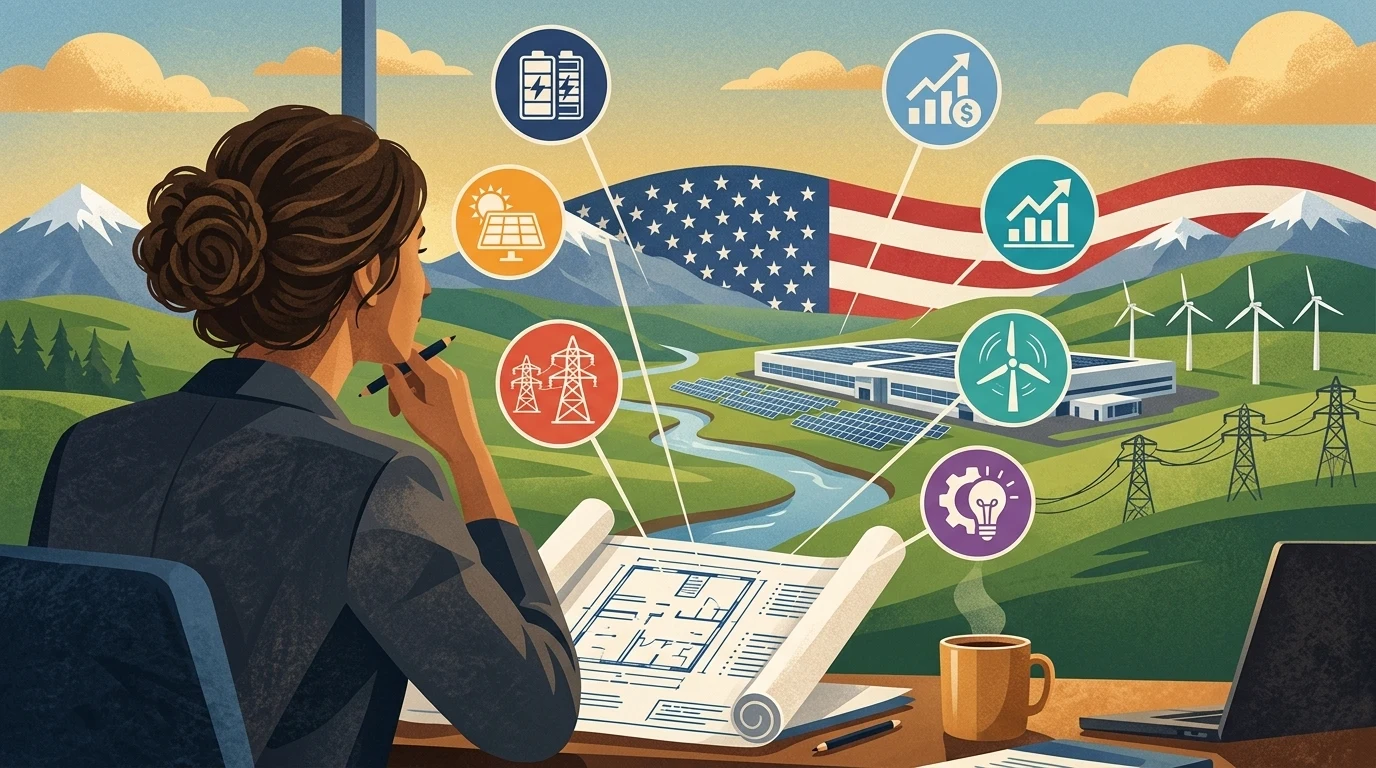
Domestic capital expenditure into advanced industrial clean manufacturing has surged past historical milestones, according to quarterly tracking data released by the Department of Energy and independent industrial analysts. Total committed investments across new battery gigafactories, photovoltaic module fabrication plants, and critical power grid transformer production facilities have exceeded two hundred billion dollars, fundamentally reshaping the manufacturing topography of the American Southeast, Rust Belt, and Southwest corridors.
This industrial resurgence represents one of the largest capital reallocations toward domestic production since the post-war era. Driven by predictable tax credits, federal loan program guarantees, and heightened corporate emphasis on supply chain sovereignty, multinational corporations and domestic industrial champions have broke ground on more than eighty major manufacturing campuses over the past twenty-four months, bringing tens of thousands of skilled union trade jobs to regions formerly impacted by deindustrialization.
Regional Economic Transformation and the 'Battery Belt'
The epicenter of this investment wave stretches along Interstate 75 and Interstate 85, a corridor increasingly recognized by market strategists as the American Battery Belt. States including Georgia, Tennessee, Kentucky, North Carolina, and Ohio have captured the lion's share of mega-scale facilities, where automotive conglomerates and their joint-venture battery partners are constructing integrated production ecosystems that span cathode synthesis, cell assembly, and commercial battery pack recycling.
State and municipal leaders point to secondary economic dividends that extend far beyond direct factory headcounts. Surrounding municipalities report substantial growth in local municipal tax revenues, technical college vocational enrollments, auxiliary precision machining contracts, and housing starts. Regional utility operators have simultaneously accelerated grid modernization projects to satisfy the massive clean baseload electricity demands required by automated high-throughput clean manufacturing facilities.
Operational Obstacles: Supply Chains, Labor, and Interconnection
Despite unprecedented capital deployment, manufacturing executives cite significant structural headwinds that threaten project commissioning timetables. The primary impediment remains severe lead-time bottlenecks for high-voltage transmission equipment, commercial step-up transformers, and specialized switchgear, with delivery backlogs frequently stretching past three years. Additionally, factory operators face an acute shortage of specialized electrical technicians, automated robotics engineers, and chemical process operators.
Raw material processing also remains an active vulnerability. While domestic module assembly and battery cell packaging capacity have expanded at exponential rates, the domestic refining of essential battery-grade minerals—including lithium hydroxide, battery synthetic graphite, nickel sulfate, and cobalt—continues to rely disproportionately on foreign supply chains. Industry leaders are actively lobbying for streamlined federal environmental permitting reform to unlock domestic mining, refining, and critical mineral reclamation projects.
Long-Term Market Projections and Industrial Competitiveness
Wall Street analysts and macroeconomic researchers anticipate that these manufacturing facilities will enter full commercial production phases between late 2026 and 2028, significantly reducing reliance on trans-Pacific logistics and mitigating vulnerability to geopolitical maritime shocks. By anchoring high-value components within domestic borders, the United States is rapidly positioning its domestic heavy manufacturing sector to compete aggressively in global high-efficiency energy technology exports throughout the decade ahead.
How this account was assessed
This explainer is built from an attributable source set rather than anonymous aggregation. The references used for the current version are: U.S. Department of Energy Investment Tracker; Federal Reserve Industrial Production Index. Each source has a different evidentiary role. A public record can establish what an institution filed or announced, while independent reporting can add chronology, interviews and context. Neither should be stretched beyond what it directly supports.
What the sources can—and cannot—show
The first step is to identify the controlling fact in every paragraph: a date, action, quotation, measurement or procedural status. That fact should be traceable to a named record. Statements about motive, cause or future impact require separate evidence and should not be inferred merely because two events occurred close together. Early official information can also change. Preliminary findings, emergency statements and initial court or agency summaries should be described as preliminary until the complete record is available.
A source’s existence is not proof of every detail in a story. Readers should check whether the linked page actually contains the quoted language or number, whether it covers the same time and place and whether a newer version has replaced it. When several reports all depend on the same original statement, they count as multiple publications but only one evidentiary origin.
Reading chronology and numbers carefully
Dates should be read in three layers: when the event happened, when the information became public and when this post was last reviewed. Keeping those moments separate prevents a later update from being projected backward. Numerical claims need the same discipline. Confirm the unit, denominator, comparison period, geographic scope and whether a figure is seasonally adjusted, inflation adjusted, estimated or final. A percentage change without its starting value can exaggerate practical significance.
Independent checks for readers
Readers can reproduce the basic review by opening each reference, searching for the central names and dates and reading beyond the headline. For government or court material, find the docket, order, transcript or downloadable dataset. For company statements, compare the announcement with a filing or regulator’s record when one exists. For scientific or technical claims, prefer the underlying paper, protocol or evaluation and check whether outside specialists have examined the method.
Why this context matters
The rapid expansion of domestic manufacturing capacity transforms local economies, employment patterns, and national supply chain resilience. Authority comes from showing the path from evidence to conclusion, not from confident tone. That is why this post keeps reference links visible, states the limits of the available material and avoids treating an unresolved question as settled.
What to watch next
Commissioning dates for major gigafactories in 2026-2027, workforce training initiative outcomes, and federal legislative discussions on permitting reform. A useful update should name the new record, summarize the change and explain whether it confirms, narrows or contradicts the earlier account. If a correction changes a central fact, the correction should remain visible instead of being silently folded into the text.
This process does not eliminate uncertainty; it makes uncertainty legible. Readers should leave with a clear understanding of what is documented, what is attributed, what is analysis and what still requires evidence. That separation is the foundation of a durable, useful blog post.
References and further reading
Compiled from Department of Energy project databases, state economic development announcements, and audited corporate quarterly reports.