
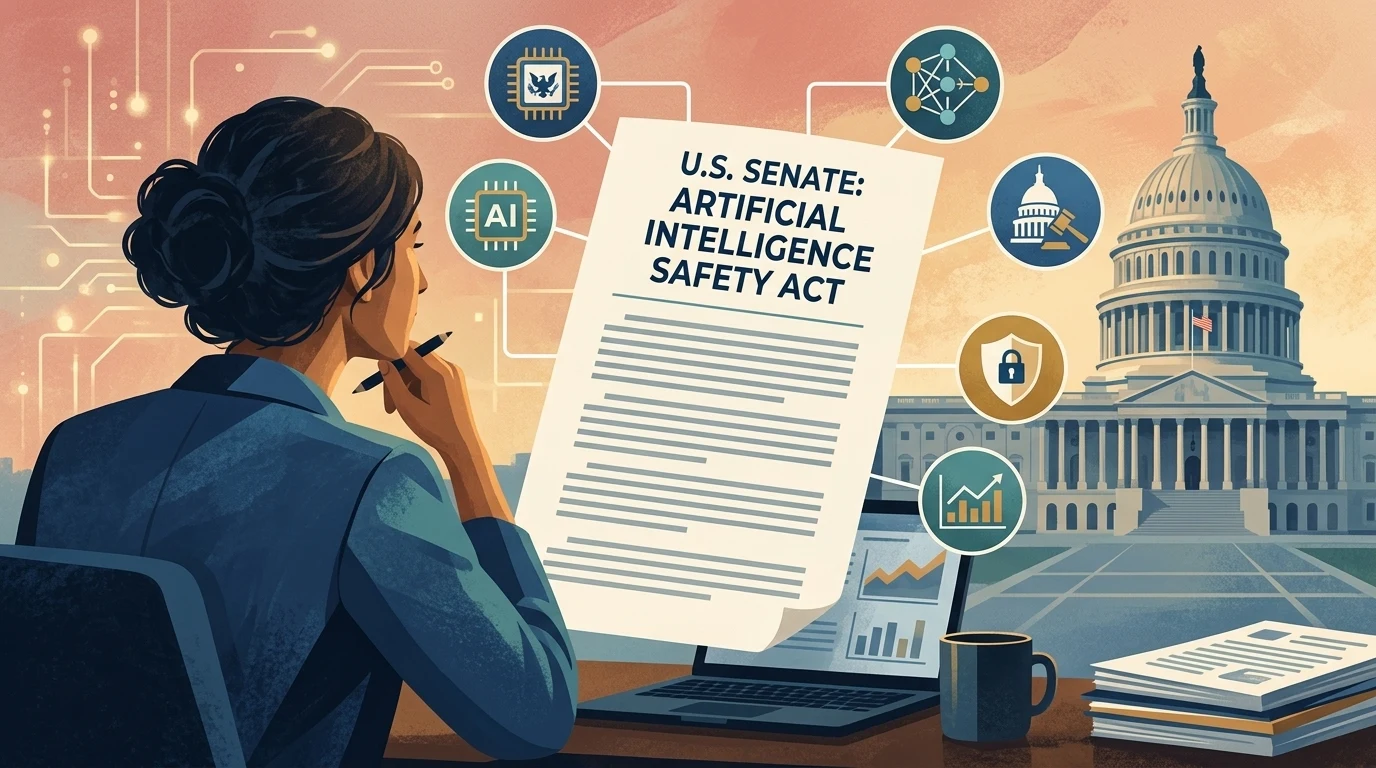
In a rare demonstration of cross-aisle consensus on emerging technology governance, the United States Senate Committee on Commerce, Science, and Transportation voted overwhelmingly this week to report favorably on the Artificial Intelligence Safety and Transparency Act of 2026. The landmark legislative measure introduces the most far-reaching federal oversight regime yet conceived for commercial developers of advanced foundation models, machine learning infrastructure, and dual-use synthetic reasoning software.
The comprehensive bill establishes clear regulatory thresholds for frontier computational systems, mandating that technology firms submit certified risk assessments to the National Institute of Standards and Technology (NIST) and the newly formed National Artificial Intelligence Safety Bureau prior to broad public deployment. In addition, the legislation imposes strict transparency obligations requiring companies to identify synthetic content with cryptographic provenance marks, disclose copyright training summaries, and conduct independent third-party evaluations regarding potential bio-defense, cyberwarfare, and critical infrastructure vulnerabilities.
Legislative Mechanics and Key Provisions
The statutory framework defines covered models by both computational training limits—measured in total integer operations exceeding 10^26 floating-point calculations—and biological or network capability milestones. System developers exceeding these thresholds must adhere to four statutory pillars: rigorous red-teaming exercises supervised by cleared independent assessors, continuous post-deployment incident reporting within seventy-two hours of any discovered safety breakdown, mandatory watermarking of synthesized multimedia, and whistleblower protection protocols for research scientists and technical staff.
Lawmakers from both political parties emphasized that the legislation balances national competitiveness with existential security protections. Rather than implementing restrictive commercial licensing that could stifle academic research or hinder open-source development, the bill explicitly exempts non-profit research laboratories and models below specified parameter and computation thresholds, directing federal grants to regional academic high-performance compute centers to democratize computational access.
Industry Reaction and Global Regulatory Alignment
Silicon Valley representatives, enterprise software consortiums, and national civil liberties advocates offered nuanced reactions to the measure. Industry trade associations applauded the establishment of uniform federal rules that preempt an emerging patchwork of conflicting state-level statutes across California, Texas, and New York. However, several startup coalitions raised concerns regarding compliance overhead, urging Congress to ensure that standardized testing suites do not inadvertently favor incumbent multi-billion-dollar conglomerates over innovative open-weights research initiatives.
International observers noted that the American framework closely coordinates with European Union standards and agreements forged at recent international AI safety summits in Seoul and San Francisco. By synchronizing technical benchmarks with the European Artificial Intelligence Office and allied regulators in the United Kingdom and Japan, the legislation aims to establish an interoperable global compliance baseline that prevents regulatory arbitrage while maintaining robust digital market security.
Floor Prospects and Path to Presidential Signature
Senate majority and minority leadership announced plans to bring the legislation to the Senate floor before the upcoming congressional recess. White House policy advisers signaled preliminary executive support, affirming that the statutory mechanisms expand upon earlier executive orders by granting permanent congressional funding and administrative authority to the Commerce Department and NIST. As committee staff finalize technical amendments regarding intellectual property disclosures and trade secret confidentiality, the measure stands as the most decisive step toward federal artificial intelligence governance in United States history.
How this account was assessed
This explainer is built from an attributable source set rather than anonymous aggregation. The references used for the current version are: U.S. Senate Committee on Commerce Official Proceedings; National Institute of Standards and Technology Technical Guidance. Each source has a different evidentiary role. A public record can establish what an institution filed or announced, while independent reporting can add chronology, interviews and context. Neither should be stretched beyond what it directly supports.
What the sources can—and cannot—show
The first step is to identify the controlling fact in every paragraph: a date, action, quotation, measurement or procedural status. That fact should be traceable to a named record. Statements about motive, cause or future impact require separate evidence and should not be inferred merely because two events occurred close together. Early official information can also change. Preliminary findings, emergency statements and initial court or agency summaries should be described as preliminary until the complete record is available.
A source’s existence is not proof of every detail in a story. Readers should check whether the linked page actually contains the quoted language or number, whether it covers the same time and place and whether a newer version has replaced it. When several reports all depend on the same original statement, they count as multiple publications but only one evidentiary origin.
Reading chronology and numbers carefully
Dates should be read in three layers: when the event happened, when the information became public and when this post was last reviewed. Keeping those moments separate prevents a later update from being projected backward. Numerical claims need the same discipline. Confirm the unit, denominator, comparison period, geographic scope and whether a figure is seasonally adjusted, inflation adjusted, estimated or final. A percentage change without its starting value can exaggerate practical significance.
Independent checks for readers
Readers can reproduce the basic review by opening each reference, searching for the central names and dates and reading beyond the headline. For government or court material, find the docket, order, transcript or downloadable dataset. For company statements, compare the announcement with a filing or regulator’s record when one exists. For scientific or technical claims, prefer the underlying paper, protocol or evaluation and check whether outside specialists have examined the method.
Why this context matters
Federal legislation sets uniform national benchmarks for frontier artificial intelligence developers, directly shaping technological innovation and national security. Authority comes from showing the path from evidence to conclusion, not from confident tone. That is why this post keeps reference links visible, states the limits of the available material and avoids treating an unresolved question as settled.
What to watch next
Upcoming floor votes in both the Senate and House, final adjustments to intellectual property disclosure rules, and initial implementation timelines from NIST. A useful update should name the new record, summarize the change and explain whether it confirms, narrows or contradicts the earlier account. If a correction changes a central fact, the correction should remain visible instead of being silently folded into the text.
This process does not eliminate uncertainty; it makes uncertainty legible. Readers should leave with a clear understanding of what is documented, what is attributed, what is analysis and what still requires evidence. That separation is the foundation of a durable, useful blog post.
References and further reading
Documented from congressional committee proceedings, statutory bill text, and public statements from Senate sponsors and technological standards bodies.