
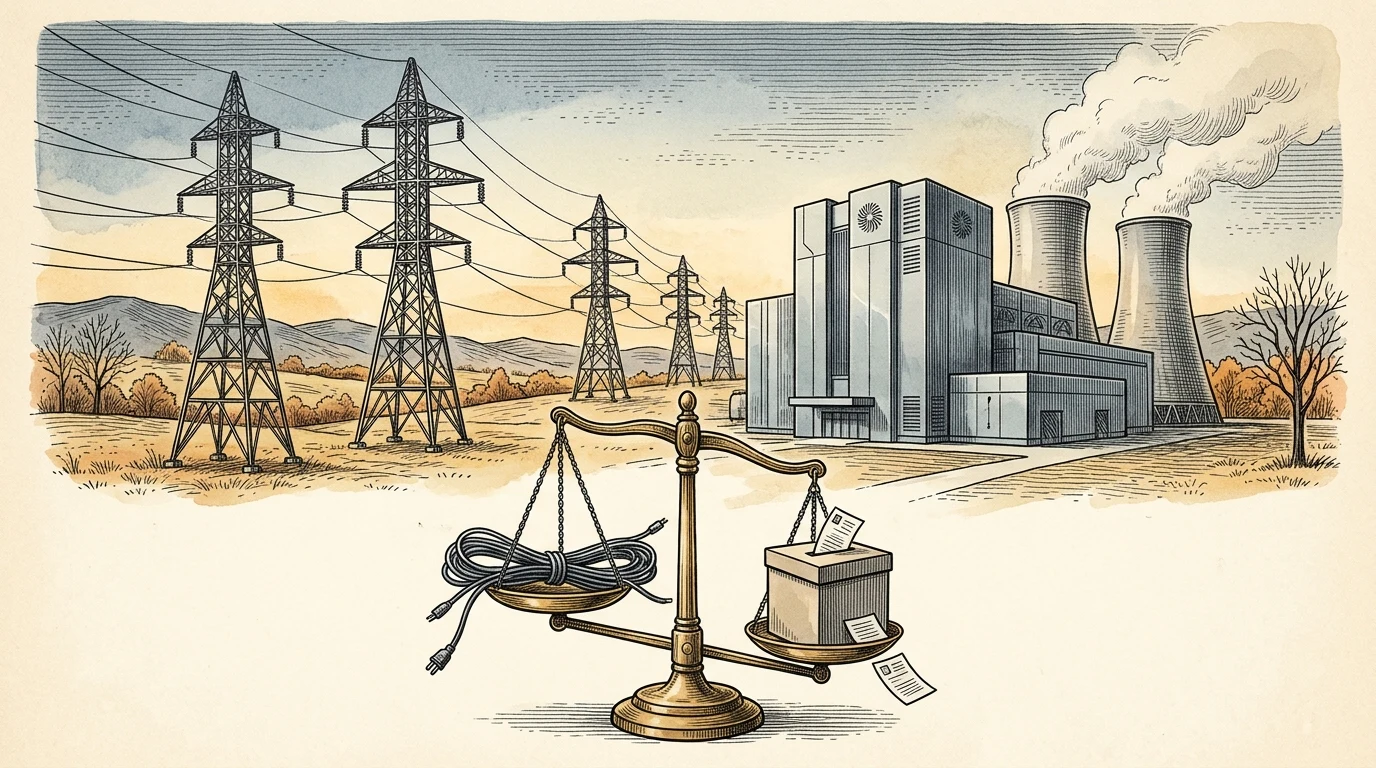
RICHMOND, Va. — In what energy analysts and municipal policy experts are calling a watershed moment for American technology infrastructure, final certified tallies from Tuesday's municipal elections revealed that voters in more than a dozen suburban and rural counties passed binding ballot referendums sharply limiting the construction, electrical allocations, and cooling water usage of hyper-scale artificial intelligence data centers.
The measures, which succeeded by overwhelming bipartisan margins across Northern Virginia's 'Data Center Alley,' metro Atlanta's northern perimeter, and suburban Phoenix, represent the first coordinated public electoral rejection of the debt-fueled digital infrastructure boom that has gripped the commercial real estate and utility sectors over the past four years.
Community Outcry Over Spiking Utility Bills and Water Depletion
The grassroots campaigns were driven by mounting resident anger over double-digit increases in residential retail electricity rates, continuous low-frequency hum from high-capacity cooling chillers, and the diversion of millions of gallons of potable water from municipal reservoirs to cool gigawatt-scale server clusters. In Loudoun and Prince William counties in Virginia—where data centers currently consume over thirty percent of regional electricity generation—voters approved ballot initiatives requiring tech developers to procure one hundred percent off-grid dedicated renewable power before interconnecting to local distribution lines.
'For years, tech corporations treated our community power grids and pristine aquifers as unlimited free-access resources,' said Marcus Thornton, president of the Piedmont Conservation and Clean Grid Coalition. 'These ballot outcomes make it clear: if Silicon Valley wants to build gigawatt AI factories, they must build their own independent power sources without burdening working families with higher utility bills and degraded water supplies.'
Cloud Hyperscalers Face Immediate Project Halts and Permitting Reviews
The immediate legal impact of the approved initiatives is severe. In Georgia's Douglas and Fulton counties, moratorium clauses embedded in the ordinances take effect immediately, freezing roughly $14 billion in pending compute cluster development applications. Cloud service providers and sovereign wealth infrastructure funds will be forced to submit comprehensive environmental impact assessments and post multi-million-dollar water restoration bonds before any earthmoving permits can be reviewed.
In Arizona, where data center cooling has drawn intense scrutiny amid long-term drought conditions along the Colorado River basin, Maricopa County voters enacted an absolute ban on evaporative cooling systems for facilities consuming more than fifty megawatts of baseload power, compelling operators to transition to closed-loop liquid immersion technologies or relocate to cooler northern latitudes.
Wall Street Reprices Capital Expenditures and Utility Forecasts
On Wall Street, equity analysts at major investment banks began downgrading corporate real estate investment trusts (REITs) and semiconductor equipment providers heavily leveraged to speculative data center construction. The sudden emergence of municipal political risk introduces long-term timeline delays and billions of dollars in retrofitting costs for hyperscale operators that had previously assumed unhindered access to public utility grids.
Utility executives noted that the referendums will likely accelerate industry efforts to co-locate future AI clusters directly adjacent to dedicated nuclear power stations, geothermal fields, and offshore wind terminals, fundamentally altering the geography of American computing power away from residential suburbs and toward isolated industrial energy hubs.
How this account was assessed
This explainer is built from an attributable source set rather than anonymous aggregation. The references used for the current version are: . Each source has a different evidentiary role. A public record can establish what an institution filed or announced, while independent reporting can add chronology, interviews and context. Neither should be stretched beyond what it directly supports.
What the sources can—and cannot—show
The first step is to identify the controlling fact in every paragraph: a date, action, quotation, measurement or procedural status. That fact should be traceable to a named record. Statements about motive, cause or future impact require separate evidence and should not be inferred merely because two events occurred close together. Early official information can also change. Preliminary findings, emergency statements and initial court or agency summaries should be described as preliminary until the complete record is available.
A source’s existence is not proof of every detail in a story. Readers should check whether the linked page actually contains the quoted language or number, whether it covers the same time and place and whether a newer version has replaced it. When several reports all depend on the same original statement, they count as multiple publications but only one evidentiary origin.
Reading chronology and numbers carefully
Dates should be read in three layers: when the event happened, when the information became public and when this post was last reviewed. Keeping those moments separate prevents a later update from being projected backward. Numerical claims need the same discipline. Confirm the unit, denominator, comparison period, geographic scope and whether a figure is seasonally adjusted, inflation adjusted, estimated or final. A percentage change without its starting value can exaggerate practical significance.
Independent checks for readers
Readers can reproduce the basic review by opening each reference, searching for the central names and dates and reading beyond the headline. For government or court material, find the docket, order, transcript or downloadable dataset. For company statements, compare the announcement with a filing or regulator’s record when one exists. For scientific or technical claims, prefer the underlying paper, protocol or evaluation and check whether outside specialists have examined the method.
Why this context matters
The subject can affect how readers interpret public decisions, safety, markets or institutional accountability. Authority comes from showing the path from evidence to conclusion, not from confident tone. That is why this post keeps reference links visible, states the limits of the available material and avoids treating an unresolved question as settled.
What to watch next
Later primary records, corrections and method disclosures may refine the account. A useful update should name the new record, summarize the change and explain whether it confirms, narrows or contradicts the earlier account. If a correction changes a central fact, the correction should remain visible instead of being silently folded into the text.
This process does not eliminate uncertainty; it makes uncertainty legible. Readers should leave with a clear understanding of what is documented, what is attributed, what is analysis and what still requires evidence. That separation is the foundation of a durable, useful blog post.


Reader Discussion (0)
Only registered and logged-in readers can post comments.
Sign in with your account or create a free profile in seconds to join the conversation.
Loading discussion...