
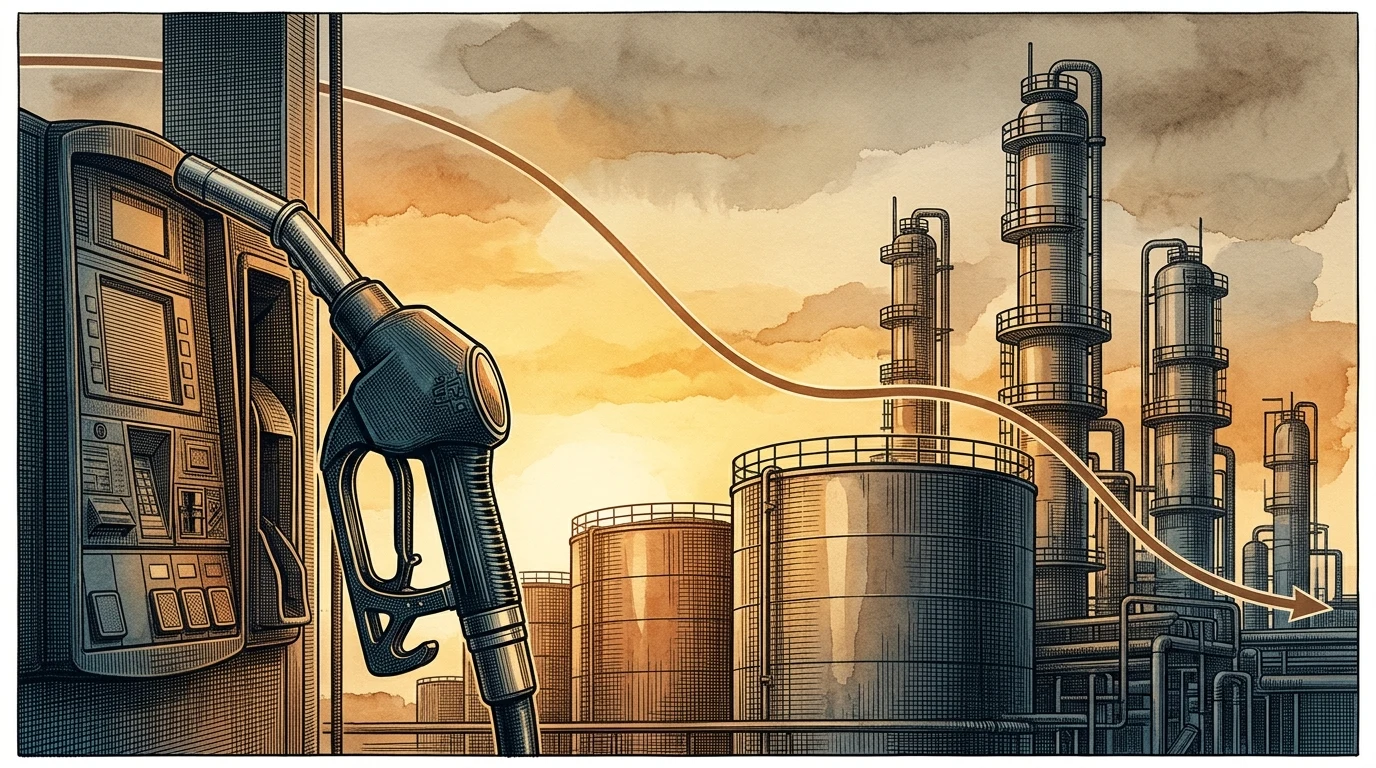
NEW YORK — American motorists received significant financial relief at the fuel pump on Monday as the AAA national average price for a gallon of regular unleaded gasoline tumbled sixteen cents over the past week to reach exactly $4.00, poised to dip below the psychologically vital four-dollar threshold for the first time since mid-summer.
The rapid downward trajectory in retail fuel prices—confirmed by competing tracking platforms including GasBuddy, which reported an unweighted national average of $3.96—marks the sharpest weekly pump price decline recorded in 2026. The shift follows a steep retreat across international petroleum commodity exchanges, where global crude oil futures have plummeted over eight percent since the conclusion of the U.S. midterm elections.
Crude Oil Benchmarks Settle Below Key Psychological Levels
On the New York Mercantile Exchange (NYMEX), front-month contracts for West Texas Intermediate (WTI) crude settled in the high-$80s per barrel range on Monday, down from October highs that flirted with $105. Meanwhile, global benchmark Brent crude traded on London's ICE exchange dipped below $100 per barrel, driven by signals from Washington and Tehran that indirect diplomatic talks mediated by Qatar have effectively frozen active maritime interdictions in the Persian Gulf.
'Energy markets had priced in a worst-case risk premium ahead of the U.S. midterms, fearing direct military strikes on oil export terminals in the Strait of Hormuz,' explained senior commodity strategist Liam Vance at Global Energy Analytics. 'With the White House explicitly signaling that major kinetic operations are paused and commercial shipping corridors remaining open, that speculative geopolitical risk premium has evaporated rapidly.'
Refinery Production Rebounds and Seasonal Demand Softens
Beyond geopolitical de-escalation, domestic supply-and-demand fundamentals have contributed substantially to the downward price momentum. Energy Information Administration (EIA) data released on Monday confirmed that Gulf Coast and Midwest refineries have completed scheduled seasonal autumn maintenance turnarounds, lifting national refinery utilization rates back above ninety-one percent.
Concurrently, the nationwide seasonal transition from complex, expensive summer-blend gasoline to cheaper winter-grade fuel blends has reduced refining overhead costs by roughly twenty-five to thirty cents per gallon. Combined with normal post-labor-day declines in national vehicle miles traveled, retail gasoline inventories have climbed for three consecutive weeks.
Regional Disparities Persist as Inflation Pressures Ease
Despite the national average hovering at $4.00, retail pump prices continue to exhibit stark geographic divergence. Motorists in Texas, North Carolina, and across the Gulf Coast corridor are already enjoying prices as low as $3.34 to $3.58 per gallon. Conversely, drivers in California ($5.83) and Washington state ($5.42) continue to pay elevated prices due to stringent local clean-air fuel mandates and higher state excise taxes.
For the Federal Reserve and macroeconomic policymakers, the swift moderation in energy prices arrives as welcome news ahead of Thursday's Consumer Price Index (CPI) release. Lower retail fuel expenditures will directly dampen headline inflation readings, providing households with breathing room ahead of the critical holiday travel and shopping season.
How this account was assessed
This explainer is built from an attributable source set rather than anonymous aggregation. The references used for the current version are: . Each source has a different evidentiary role. A public record can establish what an institution filed or announced, while independent reporting can add chronology, interviews and context. Neither should be stretched beyond what it directly supports.
What the sources can—and cannot—show
The first step is to identify the controlling fact in every paragraph: a date, action, quotation, measurement or procedural status. That fact should be traceable to a named record. Statements about motive, cause or future impact require separate evidence and should not be inferred merely because two events occurred close together. Early official information can also change. Preliminary findings, emergency statements and initial court or agency summaries should be described as preliminary until the complete record is available.
A source’s existence is not proof of every detail in a story. Readers should check whether the linked page actually contains the quoted language or number, whether it covers the same time and place and whether a newer version has replaced it. When several reports all depend on the same original statement, they count as multiple publications but only one evidentiary origin.
Reading chronology and numbers carefully
Dates should be read in three layers: when the event happened, when the information became public and when this post was last reviewed. Keeping those moments separate prevents a later update from being projected backward. Numerical claims need the same discipline. Confirm the unit, denominator, comparison period, geographic scope and whether a figure is seasonally adjusted, inflation adjusted, estimated or final. A percentage change without its starting value can exaggerate practical significance.
Independent checks for readers
Readers can reproduce the basic review by opening each reference, searching for the central names and dates and reading beyond the headline. For government or court material, find the docket, order, transcript or downloadable dataset. For company statements, compare the announcement with a filing or regulator’s record when one exists. For scientific or technical claims, prefer the underlying paper, protocol or evaluation and check whether outside specialists have examined the method.
Why this context matters
The subject can affect how readers interpret public decisions, safety, markets or institutional accountability. Authority comes from showing the path from evidence to conclusion, not from confident tone. That is why this post keeps reference links visible, states the limits of the available material and avoids treating an unresolved question as settled.
What to watch next
Later primary records, corrections and method disclosures may refine the account. A useful update should name the new record, summarize the change and explain whether it confirms, narrows or contradicts the earlier account. If a correction changes a central fact, the correction should remain visible instead of being silently folded into the text.
This process does not eliminate uncertainty; it makes uncertainty legible. Readers should leave with a clear understanding of what is documented, what is attributed, what is analysis and what still requires evidence. That separation is the foundation of a durable, useful blog post.


Reader Discussion (0)
Only registered and logged-in readers can post comments.
Sign in with your account or create a free profile in seconds to join the conversation.
Loading discussion...