
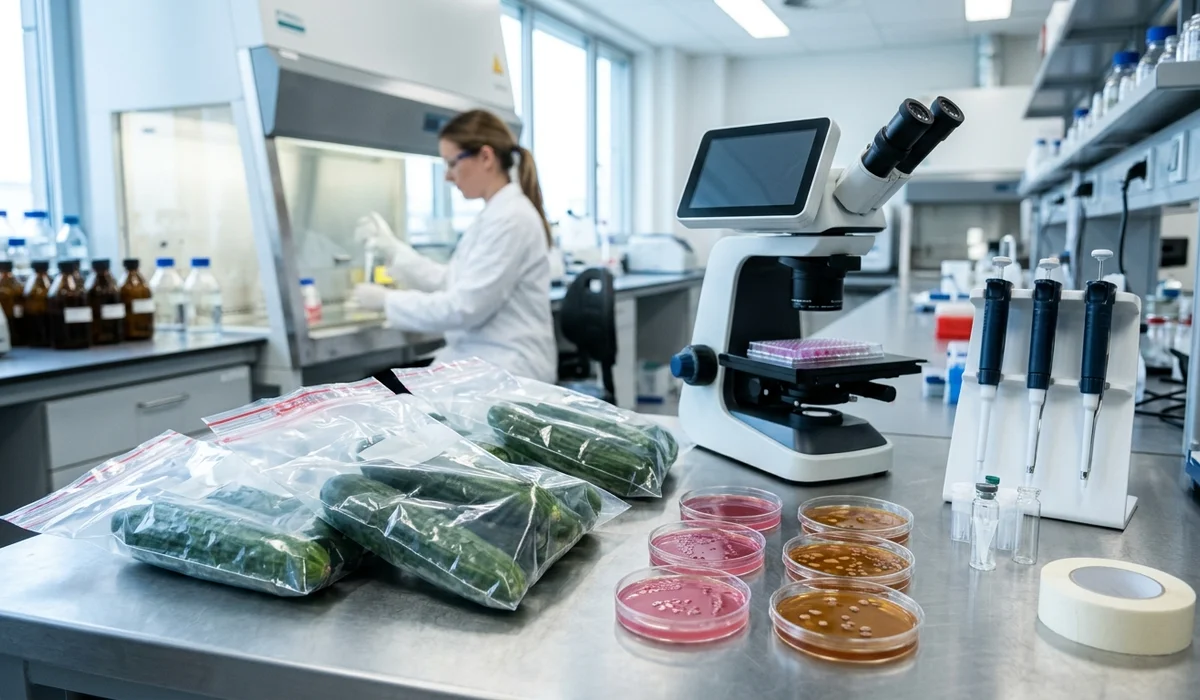
WASHINGTON/ATLANTA — Just as millions of American households prepare holiday salads, vegetable platters, and Thanksgiving feasts, the Food and Drug Administration (FDA) and the Centers for Disease Control and Prevention (CDC) issued an urgent nationwide food safety alert Wednesday warning against eating fresh slicing cucumbers linked to a sprawling multi-state Salmonella outbreak.
The recall, initiated voluntarily by Rio Rico, Arizona-based SunFed Produce, LLC in coordination with federal regulators, covers all sizes of whole fresh American cucumbers grown in Sonora, Mexico, by producer Agrotato, S.A. de C.V. and sold to retail supermarkets and foodservice distributors between October 12 and November 26. State and federal health authorities confirmed dozens of illnesses — surging past 68 reported cases and climbing toward a broader multi-state tally across at least nineteen U.S. states and five Canadian provinces — including multiple severe hospitalizations.
Traceback Investigation Pinpoints Sonora Supply Chain
Epidemiologists launched an emergency traceback investigation earlier this month after state public health laboratories flagged a cluster of Salmonella infections exhibiting identical genetic fingerprints in the CDC's PulseNet surveillance network. Detailed patient interviews quickly revealed a striking dietary pattern: a substantial majority of infected individuals reported eating fresh sliced cucumbers at home, in bagged salad mixes, or at restaurants in the week prior to falling ill.
Using electronic shipping manifests and supplier purchase invoices, FDA investigators traced the contaminated produce across multiple regional grocery wholesalers back to Agrotato's agricultural packing operations in Sonora, Mexico. On Wednesday, SunFed confirmed it immediately notified downstream retail buyers to pull remaining stock from produce aisles, bulk bins, and restaurant prep kitchens, though regulators warned that additional distributors buying from the same grower could trigger secondary recalls.
'As soon as we learned of this issue, we immediately acted to protect consumers,' SunFed President Craig Slate said in a company recall notice. 'We are working closely with authorities and the implicated ranch to determine the possible cause.'
Identifying Recalled Produce and Kitchen Sanitation
Federal food safety officials urged holiday hosts to inspect refrigerators carefully before chopping produce for Thursday's gatherings. Affected cucumbers were shipped in bulk cardboard containers labeled 'SunFed' or packaged in generic white boxes or black plastic crates bearing the sticker 'Agrotato, S.A. de C.V.' Individual cucumbers sold loose in grocery produce bins typically display a sticker reading 'SunFed Mexico.'
Crucially, because fresh produce stickers can fall off and many shoppers discard outer bulk cartons, the CDC advised consumers: if you purchased whole fresh American slicing cucumbers since mid-October and cannot verify with your grocer where they were grown, throw them away immediately rather than risking exposure. Note that long English cucumbers wrapped in clear plastic and mini seedless cucumbers are not included in this recall.
Recognizing Symptoms of Salmonellosis
Salmonella bacteria cause acute gastroenteritis characterized by diarrhea (which can become bloody), fever over 102°F, and painful abdominal cramps appearing six hours to six days after eating contaminated produce. While most healthy adults recover within four to seven days without antibiotics, young children, seniors over 65, and immunocompromised individuals risk life-threatening bloodstream infections requiring emergency hospitalization.
CDC authorities also reminded families to wash cutting boards, vegetable peelers, knives, and refrigerator crisper drawers thoroughly with hot soapy water or sanitize them in a high-temperature dishwasher cycle if recalled cucumbers were stored inside the kitchen.
How this account was assessed
This explainer is built from an attributable source set rather than anonymous aggregation. The references used for the current version are: . Each source has a different evidentiary role. A public record can establish what an institution filed or announced, while independent reporting can add chronology, interviews and context. Neither should be stretched beyond what it directly supports.
What the sources can—and cannot—show
The first step is to identify the controlling fact in every paragraph: a date, action, quotation, measurement or procedural status. That fact should be traceable to a named record. Statements about motive, cause or future impact require separate evidence and should not be inferred merely because two events occurred close together. Early official information can also change. Preliminary findings, emergency statements and initial court or agency summaries should be described as preliminary until the complete record is available.
A source’s existence is not proof of every detail in a story. Readers should check whether the linked page actually contains the quoted language or number, whether it covers the same time and place and whether a newer version has replaced it. When several reports all depend on the same original statement, they count as multiple publications but only one evidentiary origin.
Reading chronology and numbers carefully
Dates should be read in three layers: when the event happened, when the information became public and when this post was last reviewed. Keeping those moments separate prevents a later update from being projected backward. Numerical claims need the same discipline. Confirm the unit, denominator, comparison period, geographic scope and whether a figure is seasonally adjusted, inflation adjusted, estimated or final. A percentage change without its starting value can exaggerate practical significance.
Independent checks for readers
Readers can reproduce the basic review by opening each reference, searching for the central names and dates and reading beyond the headline. For government or court material, find the docket, order, transcript or downloadable dataset. For company statements, compare the announcement with a filing or regulator’s record when one exists. For scientific or technical claims, prefer the underlying paper, protocol or evaluation and check whether outside specialists have examined the method.
Why this context matters
The subject can affect how readers interpret public decisions, safety, markets or institutional accountability. Authority comes from showing the path from evidence to conclusion, not from confident tone. That is why this post keeps reference links visible, states the limits of the available material and avoids treating an unresolved question as settled.
What to watch next
Later primary records, corrections and method disclosures may refine the account. A useful update should name the new record, summarize the change and explain whether it confirms, narrows or contradicts the earlier account. If a correction changes a central fact, the correction should remain visible instead of being silently folded into the text.
This process does not eliminate uncertainty; it makes uncertainty legible. Readers should leave with a clear understanding of what is documented, what is attributed, what is analysis and what still requires evidence. That separation is the foundation of a durable, useful blog post.




Reader Discussion (0)
Only registered and logged-in readers can post comments.
Sign in with your account or create a free profile in seconds to join the conversation.
Loading discussion...