
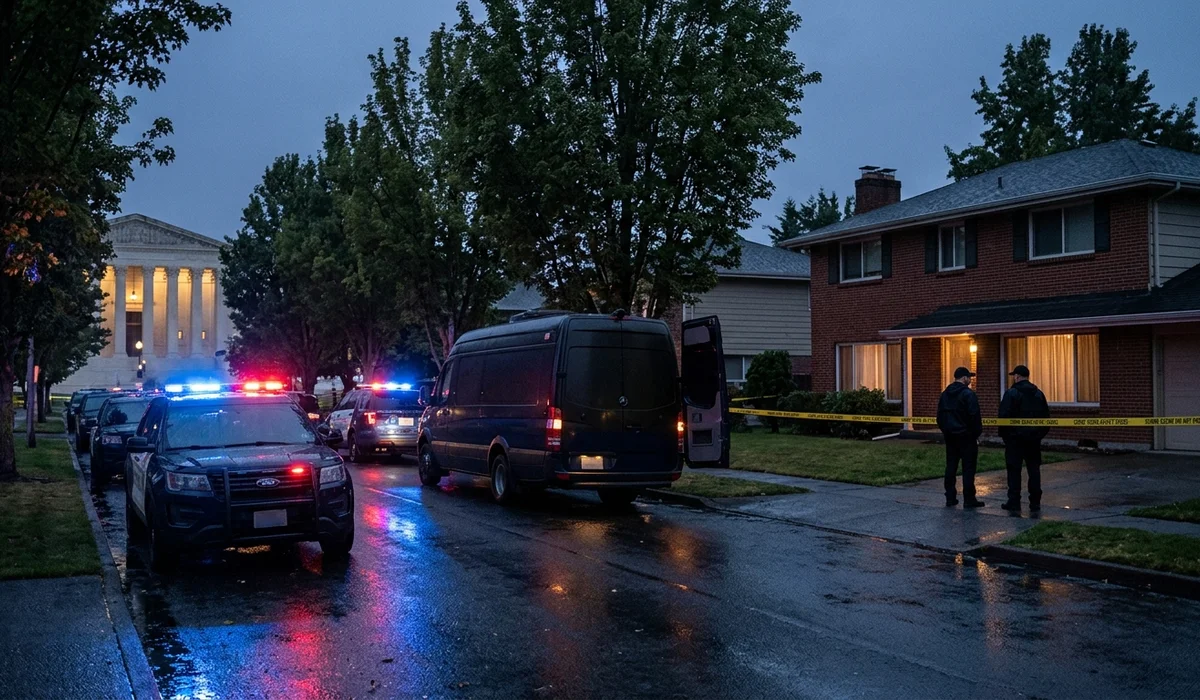
WASHINGTON — Federal and local law enforcement agencies mobilized across multiple states on Thanksgiving Eve after a coordinated wave of bomb threats and armed "swatting" hoaxes targeted President-elect Donald J. Trump's incoming Cabinet nominees and senior administration appointees.
The FBI confirmed in a formal statement Wednesday afternoon that agents are actively investigating numerous security incidents directed at political appointees since Tuesday night, working in close coordination with state police, U.S. Capitol Police, and local bomb squads. Transition spokesperson Karoline Leavitt disclosed that targets ranged from pipe-bomb threats to false emergency dispatches designed to trigger heavily armed SWAT team deployments at private family homes.
Targeted Residences Span New York, Florida, and Washington
Among those publicly confirming incidents Wednesday were former New York Rep. Lee Zeldin, tapped to lead the Environmental Protection Agency; New York Rep. Elise Stefanik, Trump's nominee for U.S. Ambassador to the United Nations; Defense Secretary nominee Pete Hegseth; Labor Secretary pick Lori Chavez-DeRemer; Agriculture nominee Brooke Rollins; CIA Director nominee John Ratcliffe; and Commerce Secretary pick Howard Lutnick.
Zeldin reported on social media that a pipe-bomb threat containing a 'pro-Palestinian themed message' had been directed at his Long Island residence while he and his family were away. Police officers swept the property with explosive-detection canines and confirmed no device was present. Similarly, Stefanik's office confirmed that while driving back from Washington to Saratoga County, New York, with her husband and three-year-old son for Thanksgiving, authorities alerted her that her residence had been targeted by a bomb threat.
In Tennessee, local police briefly blocked off the neighborhood surrounding Hegseth's home Wednesday morning after a caller falsely claimed a pipe-bomb emergency inside the residence. Brooke Rollins likewise confirmed law enforcement safely cleared her Texas home after an early-morning threat, praising responding officers for acting swiftly to protect her children.
Bipartisan Condemnation and Transition Appointments Continue
Both the Trump-Vance transition team and President Joe Biden's White House condemned the harassment campaign unequivocally. 'Last night and this morning, several of President Trump's Cabinet nominees and Administration appointees were targeted in violent, un-American threats to their lives and those who live with them,' Leavitt said. 'With President Trump as our example, dangerous acts of intimidation and violence will not deter us.'
White House spokesperson Saloni Sharma echoed the condemnation, confirming President Biden had been briefed on the threats and emphasizing that 'there is no place in our country for political violence or threats against public servants and their families.'
Even amid heightened Secret Service and local police patrols around transition personnel, Trump pressed forward Wednesday with additional high-profile national security nominations, naming retired Army Lt. Gen. Keith Kellogg as Assistant to the President and Special Envoy for Ukraine and Russia alongside trade attorney Jamieson Greer as U.S. Trade Representative.
Mounting Concern Over Swatting Weaponization
Law enforcement analysts noted Wednesday's spree underscores a troubling national surge in anonymous 'swatting' attacks — wherein perpetrators utilize encrypted Voice-over-IP routing and spoofed caller IDs to summon heavily armed tactical units to lawmakers', judges', and election officials' residences.
Because federal authorities treat interstate threat transmissions and swatting hoaxes as felony violations carrying decades in prison if bodily harm occurs, FBI cyber forensics specialists are subpoenaing telecommunications logs and digital messaging headers to unmask the perpetrators behind the Thanksgiving Eve intimidation wave.
How this account was assessed
This explainer is built from an attributable source set rather than anonymous aggregation. The references used for the current version are: . Each source has a different evidentiary role. A public record can establish what an institution filed or announced, while independent reporting can add chronology, interviews and context. Neither should be stretched beyond what it directly supports.
What the sources can—and cannot—show
The first step is to identify the controlling fact in every paragraph: a date, action, quotation, measurement or procedural status. That fact should be traceable to a named record. Statements about motive, cause or future impact require separate evidence and should not be inferred merely because two events occurred close together. Early official information can also change. Preliminary findings, emergency statements and initial court or agency summaries should be described as preliminary until the complete record is available.
A source’s existence is not proof of every detail in a story. Readers should check whether the linked page actually contains the quoted language or number, whether it covers the same time and place and whether a newer version has replaced it. When several reports all depend on the same original statement, they count as multiple publications but only one evidentiary origin.
Reading chronology and numbers carefully
Dates should be read in three layers: when the event happened, when the information became public and when this post was last reviewed. Keeping those moments separate prevents a later update from being projected backward. Numerical claims need the same discipline. Confirm the unit, denominator, comparison period, geographic scope and whether a figure is seasonally adjusted, inflation adjusted, estimated or final. A percentage change without its starting value can exaggerate practical significance.
Independent checks for readers
Readers can reproduce the basic review by opening each reference, searching for the central names and dates and reading beyond the headline. For government or court material, find the docket, order, transcript or downloadable dataset. For company statements, compare the announcement with a filing or regulator’s record when one exists. For scientific or technical claims, prefer the underlying paper, protocol or evaluation and check whether outside specialists have examined the method.
Why this context matters
The subject can affect how readers interpret public decisions, safety, markets or institutional accountability. Authority comes from showing the path from evidence to conclusion, not from confident tone. That is why this post keeps reference links visible, states the limits of the available material and avoids treating an unresolved question as settled.
What to watch next
Later primary records, corrections and method disclosures may refine the account. A useful update should name the new record, summarize the change and explain whether it confirms, narrows or contradicts the earlier account. If a correction changes a central fact, the correction should remain visible instead of being silently folded into the text.
This process does not eliminate uncertainty; it makes uncertainty legible. Readers should leave with a clear understanding of what is documented, what is attributed, what is analysis and what still requires evidence. That separation is the foundation of a durable, useful blog post.


Reader Discussion (0)
Only registered and logged-in readers can post comments.
Sign in with your account or create a free profile in seconds to join the conversation.
Loading discussion...