
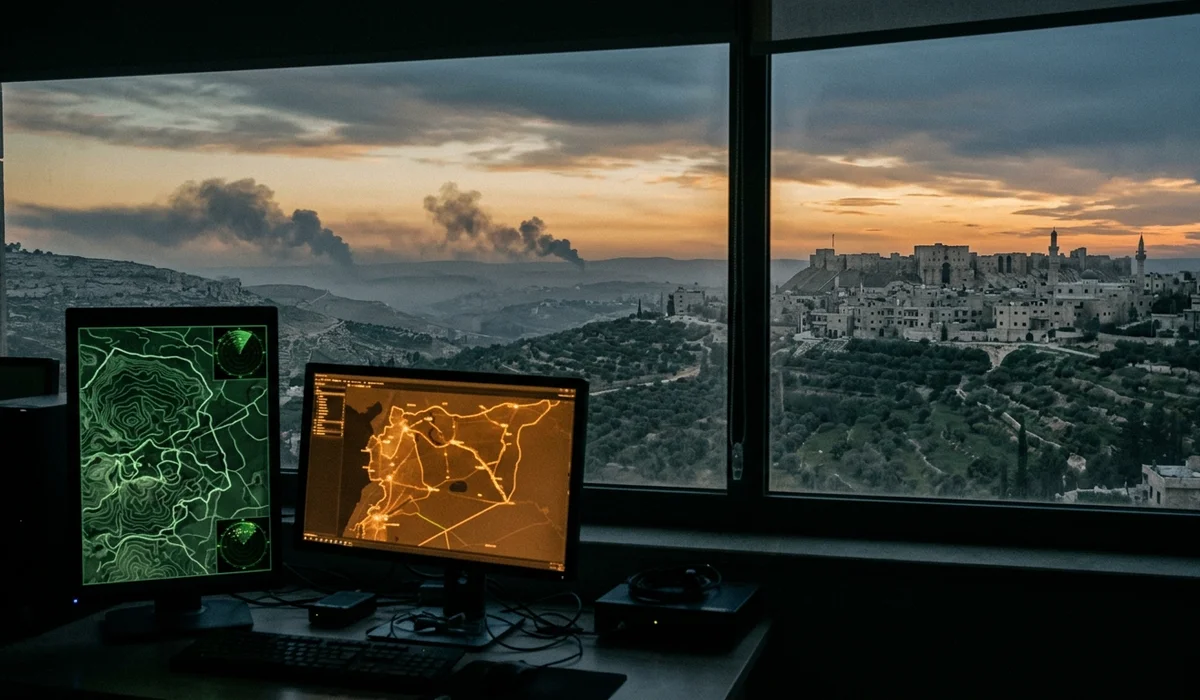
BEIRUT/AMMAN — Shattering nearly four years of frozen frontlines across northwestern Syria, an armed coalition of Syrian opposition groups launched a massive, surprise offensive Wednesday against government positions in the western Aleppo countryside, igniting the heaviest fighting in the war-ravaged nation since 2020.
The coordinated assault — announced at dawn by a joint military operations room spearheaded by Hayat Tahrir al-Sham (HTS) alongside allied Turkish-backed rebel factions — targeted fortified Syrian Arab Army trenches, artillery batteries, and supply lines stretching west of Aleppo, Syria's pre-war commercial capital. Within hours of opening artillery barrages and explosive drone swarms, insurgents overran more than a dozen villages and captured the strategic Regiment 46 military base along the vital M5 highway corridor linking Aleppo to Damascus.
Exploiting a Weakened Axis of Resistance
Regional defense analysts noted the striking timing of Wednesday's offensive, which erupted within hours of the 4:00 a.m. ceasefire taking effect across the border in Lebanon between Israel and Hezbollah. Over the past fourteen months, President Bashar al-Assad's regime had grown increasingly exposed as its two indispensable foreign lifelines suffered severe strategic attrition: Hezbollah redeployed thousands of seasoned fighters out of Syria to battle Israel in southern Lebanon, while Russian military aviation and logistics remain overwhelmingly tied down in the grinding war in Ukraine.
Meanwhile, sustained Israeli airstrikes across Syrian territory in recent months systematically degraded Iranian Revolutionary Guard Corps (IRGC) weapons depots, radar sites, and command nodes operating near Aleppo and Homs. Rebel commanders framed Wednesday's operation — dubbed 'Deterrence of Aggression' — as a defensive preemption against escalating Russian and Syrian artillery shelling of densely populated displaced civilian camps inside Idlib province.
Heavy Casualties and Russian Retaliatory Strikes
By Wednesday evening, war monitors including the Syrian Observatory for Human Rights reported intense close-quarters combat within six miles of Aleppo's outer western suburbs, leaving dozens of Syrian regime soldiers and opposition fighters killed on both sides and prompting frantic civilian evacuations across rural towns.
In Damascus, Syria's Defense Ministry acknowledged fierce battles along an extended front, stating that Syrian troops backed by allied militias were engaged in heavy counter-operations to repel what state media described as 'terrorist attacks.' Simultaneously, Russian Su-34 fighter-bombers operating from Khmeimim Air Base carried out waves of retaliatory airstrikes targeting insurgent staging depots across Idlib and Darat Izza.
Geopolitical Fallout for Turkey, Iran, and Washington
The sudden collapse of the 2020 Russian-Turkish de-escalation agreement confronts regional powers with acute diplomatic peril. Turkey, which maintains military observation posts across northern Syria and backs elements of the Syrian National Army, has grown increasingly frustrated by Assad's refusal to negotiate a political settlement that would permit millions of Syrian refugees to return home safely.
For Washington, where roughly 900 U.S. troops remain stationed in eastern Syria alongside Kurdish-led Syrian Democratic Forces to prevent a resurgence of ISIS, Pentagon planners are closely monitoring whether rapid instability around Aleppo risks triggering a wider multi-front conflagration across the Levant.
How this account was assessed
This explainer is built from an attributable source set rather than anonymous aggregation. The references used for the current version are: . Each source has a different evidentiary role. A public record can establish what an institution filed or announced, while independent reporting can add chronology, interviews and context. Neither should be stretched beyond what it directly supports.
What the sources can—and cannot—show
The first step is to identify the controlling fact in every paragraph: a date, action, quotation, measurement or procedural status. That fact should be traceable to a named record. Statements about motive, cause or future impact require separate evidence and should not be inferred merely because two events occurred close together. Early official information can also change. Preliminary findings, emergency statements and initial court or agency summaries should be described as preliminary until the complete record is available.
A source’s existence is not proof of every detail in a story. Readers should check whether the linked page actually contains the quoted language or number, whether it covers the same time and place and whether a newer version has replaced it. When several reports all depend on the same original statement, they count as multiple publications but only one evidentiary origin.
Reading chronology and numbers carefully
Dates should be read in three layers: when the event happened, when the information became public and when this post was last reviewed. Keeping those moments separate prevents a later update from being projected backward. Numerical claims need the same discipline. Confirm the unit, denominator, comparison period, geographic scope and whether a figure is seasonally adjusted, inflation adjusted, estimated or final. A percentage change without its starting value can exaggerate practical significance.
Independent checks for readers
Readers can reproduce the basic review by opening each reference, searching for the central names and dates and reading beyond the headline. For government or court material, find the docket, order, transcript or downloadable dataset. For company statements, compare the announcement with a filing or regulator’s record when one exists. For scientific or technical claims, prefer the underlying paper, protocol or evaluation and check whether outside specialists have examined the method.
Why this context matters
The subject can affect how readers interpret public decisions, safety, markets or institutional accountability. Authority comes from showing the path from evidence to conclusion, not from confident tone. That is why this post keeps reference links visible, states the limits of the available material and avoids treating an unresolved question as settled.
What to watch next
Later primary records, corrections and method disclosures may refine the account. A useful update should name the new record, summarize the change and explain whether it confirms, narrows or contradicts the earlier account. If a correction changes a central fact, the correction should remain visible instead of being silently folded into the text.
This process does not eliminate uncertainty; it makes uncertainty legible. Readers should leave with a clear understanding of what is documented, what is attributed, what is analysis and what still requires evidence. That separation is the foundation of a durable, useful blog post.




Reader Discussion (0)
Only registered and logged-in readers can post comments.
Sign in with your account or create a free profile in seconds to join the conversation.
Loading discussion...