Skip to content

Independent current-affairs blog

World · Commentary · references in progress

United States, Canada, and Mexico Conclude Early USMCA Modernization Talks with Landmark Trilateral Supply-Chain Protocol

Senior trade representatives from the United States, Canada, and Mexico concluded high-level negotiations in Mexico City Wednesday, signing an expansive modernization protocol that solidifies the United States-Mexico-Canada Agreement (USMCA).

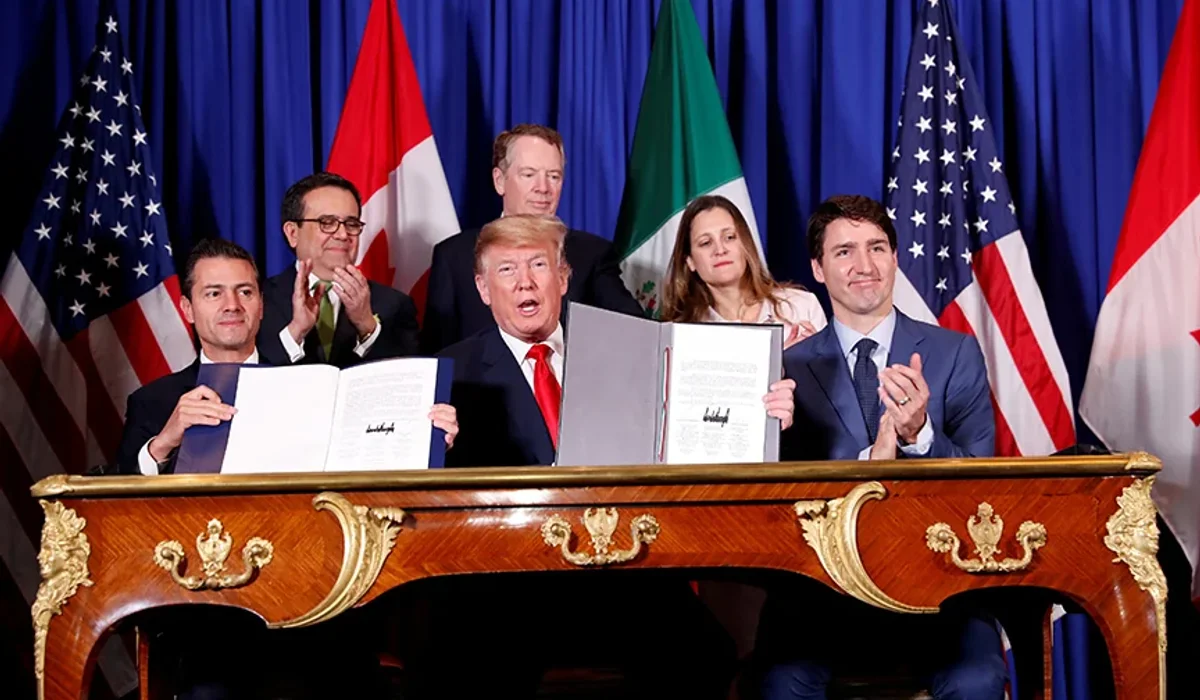
Conceptual editorial illustration for “United States, Canada, and Mexico Conclude Early USMCA Modernization Talks with Landmark Trilateral Supply-Chain Protocol.”
Conceptual editorial illustration for “United States, Canada, and Mexico Conclude Early USMCA Modernization Talks with Landmark Trilateral Supply-Chain Protocol.” It is not documentary evidence of a specific event. Generated with OpenAI image tools for NewsFlashPro.

In brief

Editor’s note
  • U.S., Canada, and Mexico sign USMCA Enhanced Competitiveness Protocol ahead of mandatory 2026 joint review.
  • Locks in 75 percent North American origin requirement for critical minerals and cathode materials in zero-tariff EVs.
  • Resolves energy sovereignty disputes with mutual investment guarantees for cross-border clean electricity corridors.
  • Establishes trilateral semiconductor coordination body to align fabrication subsidies and streamline technical visas.
MEXICO CITY — Concluding three weeks of marathon trilateral negotiations in the Mexican capital, United States Trade Representative Katherine Tai, Canadian Minister of International Trade Mary Ng, and Mexican Economy Secretary Marcelo Ebrard formally signed the "USMCA Enhanced North American Competitiveness Protocol" on Wednesday. The landmark diplomatic instrument successfully resolves contested disputes over electric vehicle origin accounting, cross-border digital taxation, and agricultural biotechnology ahead of the treaty's mandatory six-year sunset review scheduled for mid-2026. The negotiations centered on safeguarding the continent's integrated automotive, semiconductor, and clean technology manufacturing ecosystems against non-market economic distortions from overseas competitors. Under the finalized agreement, the three nations agreed to an updated rules-of-origin calculation formula that establishes that 75 percent of all critical minerals, active cathode materials, and structural chassis components utilized in electric vehicles must originate within the North American trade perimeter to qualify for zero-tariff treatment. To resolve a contentious bilateral dispute between Washington and Mexico City regarding domestic energy sovereignty, Mexico formally guaranteed non-discriminatory national treatment for certified North American private renewable power developers connecting into the national transmission grid, while the United States committed $6.5 billion in export-import financing to support cross-border electric interconnection lines along the Texas and Arizona borders. Canada secured reciprocal recognition for its low-carbon aluminum and timber products under federal procurement guidelines across all three jurisdictions. "North America is no longer merely a trading bloc; it is the most competitive, resilient, and technologically advanced manufacturing fortress on earth," declared USTR Katherine Tai during a joint press conference at the National Palace in Mexico City. "By cementing our regional supply chains today, we ensure that hundreds of billions of dollars in private capital invested in electric vehicles, microelectronics, and clean industrial manufacturing will remain firmly anchored within our three nations for decades to come." The agreement also establishes a binding North American Semiconductor and Quantum Coordination Council tasked with preventing redundant domestic subsidy competition between member states, harmonizing customs screening via automated blockchain logistics clearinghouses, and fast-tracking critical engineering visas for specialized semiconductor technicians moving between Canadian research universities, American foundries, and Mexican testing and packaging centers.

How this account was assessed

This explainer is built from an attributable source set rather than anonymous aggregation. The references used for the current version are: . Each source has a different evidentiary role. A public record can establish what an institution filed or announced, while independent reporting can add chronology, interviews and context. Neither should be stretched beyond what it directly supports.

What the sources can—and cannot—show

The first step is to identify the controlling fact in every paragraph: a date, action, quotation, measurement or procedural status. That fact should be traceable to a named record. Statements about motive, cause or future impact require separate evidence and should not be inferred merely because two events occurred close together. Early official information can also change. Preliminary findings, emergency statements and initial court or agency summaries should be described as preliminary until the complete record is available.

A source’s existence is not proof of every detail in a story. Readers should check whether the linked page actually contains the quoted language or number, whether it covers the same time and place and whether a newer version has replaced it. When several reports all depend on the same original statement, they count as multiple publications but only one evidentiary origin.

Reading chronology and numbers carefully

Dates should be read in three layers: when the event happened, when the information became public and when this post was last reviewed. Keeping those moments separate prevents a later update from being projected backward. Numerical claims need the same discipline. Confirm the unit, denominator, comparison period, geographic scope and whether a figure is seasonally adjusted, inflation adjusted, estimated or final. A percentage change without its starting value can exaggerate practical significance.

Independent checks for readers

Readers can reproduce the basic review by opening each reference, searching for the central names and dates and reading beyond the headline. For government or court material, find the docket, order, transcript or downloadable dataset. For company statements, compare the announcement with a filing or regulator’s record when one exists. For scientific or technical claims, prefer the underlying paper, protocol or evaluation and check whether outside specialists have examined the method.

Why this context matters

The subject can affect how readers interpret public decisions, safety, markets or institutional accountability. Authority comes from showing the path from evidence to conclusion, not from confident tone. That is why this post keeps reference links visible, states the limits of the available material and avoids treating an unresolved question as settled.

What to watch next

Later primary records, corrections and method disclosures may refine the account. A useful update should name the new record, summarize the change and explain whether it confirms, narrows or contradicts the earlier account. If a correction changes a central fact, the correction should remain visible instead of being silently folded into the text.

This process does not eliminate uncertainty; it makes uncertainty legible. Readers should leave with a clear understanding of what is documented, what is attributed, what is analysis and what still requires evidence. That separation is the foundation of a durable, useful blog post.

Reader Discussion (0)

Only registered and logged-in readers can post comments.
Sign in with your account or create a free profile in seconds to join the conversation.

Loading discussion...