
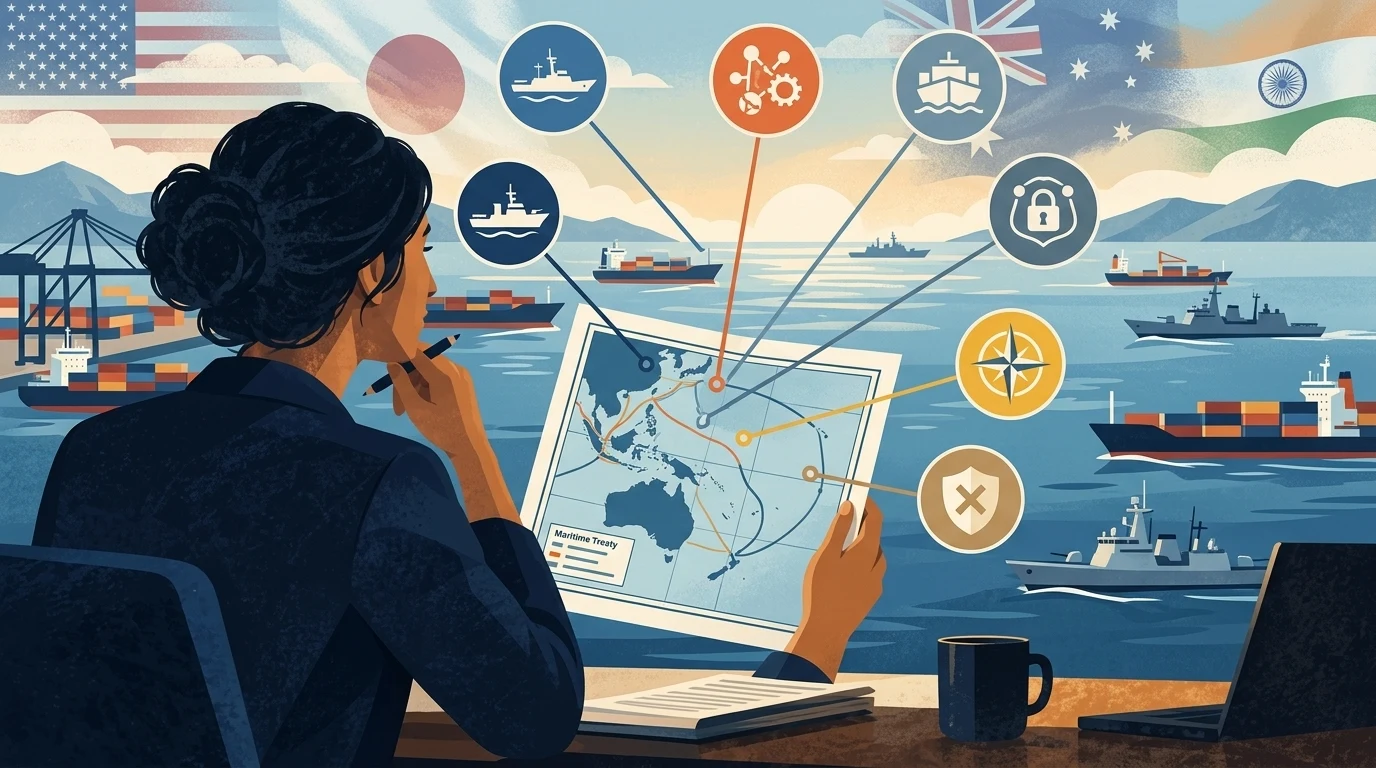
Diplomatic and defense ministers from the United States, Japan, Australia, the Philippines, and the Republic of Korea gathered at a historic summit in Honolulu, Hawaii, to formally sign the Indo-Pacific Maritime Resiliency and Strategic Resource Accord. The comprehensive treaty represents the most unified multilateral defense and economic initiative established in the region in over five decades, specifically designed to protect open commercial navigation, counter illegal maritime grey-zone coercion, and secure strategic transport corridors for vital industrial commodities.
Under the provisions of the accord, partner nations will establish a combined maritime surveillance operations center, conduct joint naval and coast guard patrols across vital maritime straits, and create a shared strategic reserve mechanism for essential minerals including rare earths, titanium, refined lithium, and gallium. The treaty underscores the growing intersection between geopolitical security commitments and modern industrial supply chain stability.
Strengthening Freedom of Navigation and Interoperability
The security framework establishes permanent shared maritime domain awareness networks powered by satellite radar constellations, unmanned aerial maritime reconnaissance drones, and integrated naval data links. Joint naval patrols will operate systematically throughout international waters in the South China Sea, the Luzon Strait, and the Sea of Japan to uphold established United Nations Convention on the Law of the Sea (UNCLOS) principles regarding unimpeded navigation rights.
Military strategists note that the pact significantly elevates defense industrial interoperability among allied armed forces. The agreement establishes reciprocal naval maintenance arrangements permitting United States surface combatants and allied auxiliary vessels to undergo drydock maintenance, repairs, and supply replenishment at regional commercial shipyards in Subic Bay, Yokosuka, and Busan, dramatically improving fleet readiness without expanding permanent overseas base footprints.
Economic Security: De-Risking Strategic Trade Corridors
Beyond mutual defense coordination, the treaty introduces an economic security chapter establishing an Allied Mineral Security Alliance. Recognizing that critical mineral processing remains heavily concentrated within single supplier nations, the signatories agreed to deploy joint development finance loans to construct multi-billion-dollar mineral refining complexes in Australia and the continental United States. This includes co-financed facilities capable of processing rare earth elements essential for defense electronics, radar arrays, and commercial aerospace guidance hardware.
The accord further incorporates an emergency mutual-support mechanism that triggers automated commodity sharing and strategic stockpile reallocations if any signatory experiences maritime blockades, embargoes, or export restrictions. Business leaders across Tokyo, Seoul, and Washington praised the stability safeguards, noting that maritime freight insurance rates in key regional shipping lanes are expected to normalize as joint naval presence expands.
Diplomatic Reactions and Global Geopolitical Balance
The ratification has drawn scrutiny from regional competitors who characterized the coalition as an attempt to construct an exclusive maritime bloc. In response, United States diplomatic envoys emphasized during closing summit remarks that the accord is strictly defensive and open to accession by other Indo-Pacific nations that share commitments to international rule of law, environmental stewardship, and open commercial oceans.
As initial joint naval exercises commence later this month, the Honolulu Accord marks a pivotal milestone in 21st-century diplomacy, seamlessly uniting national defense capabilities with economic security strategies to ensure peace and commercial vitality across the world's most dynamic oceanic trade routes.
How this account was assessed
This explainer is built from an attributable source set rather than anonymous aggregation. The references used for the current version are: U.S. Department of State Official Press Releases; Ministry of Foreign Affairs of Japan Diplomatic Statements. Each source has a different evidentiary role. A public record can establish what an institution filed or announced, while independent reporting can add chronology, interviews and context. Neither should be stretched beyond what it directly supports.
What the sources can—and cannot—show
The first step is to identify the controlling fact in every paragraph: a date, action, quotation, measurement or procedural status. That fact should be traceable to a named record. Statements about motive, cause or future impact require separate evidence and should not be inferred merely because two events occurred close together. Early official information can also change. Preliminary findings, emergency statements and initial court or agency summaries should be described as preliminary until the complete record is available.
A source’s existence is not proof of every detail in a story. Readers should check whether the linked page actually contains the quoted language or number, whether it covers the same time and place and whether a newer version has replaced it. When several reports all depend on the same original statement, they count as multiple publications but only one evidentiary origin.
Reading chronology and numbers carefully
Dates should be read in three layers: when the event happened, when the information became public and when this post was last reviewed. Keeping those moments separate prevents a later update from being projected backward. Numerical claims need the same discipline. Confirm the unit, denominator, comparison period, geographic scope and whether a figure is seasonally adjusted, inflation adjusted, estimated or final. A percentage change without its starting value can exaggerate practical significance.
Independent checks for readers
Readers can reproduce the basic review by opening each reference, searching for the central names and dates and reading beyond the headline. For government or court material, find the docket, order, transcript or downloadable dataset. For company statements, compare the announcement with a filing or regulator’s record when one exists. For scientific or technical claims, prefer the underlying paper, protocol or evaluation and check whether outside specialists have examined the method.
Why this context matters
The pact bridges military deterrence and industrial supply chain security across the world's highest-volume international shipping channels. Authority comes from showing the path from evidence to conclusion, not from confident tone. That is why this post keeps reference links visible, states the limits of the available material and avoids treating an unresolved question as settled.
What to watch next
Schedule of initial joint naval patrols in the Luzon Strait, private sector capital commitments for mineral refineries, and regional diplomatic responses. A useful update should name the new record, summarize the change and explain whether it confirms, narrows or contradicts the earlier account. If a correction changes a central fact, the correction should remain visible instead of being silently folded into the text.
This process does not eliminate uncertainty; it makes uncertainty legible. Readers should leave with a clear understanding of what is documented, what is attributed, what is analysis and what still requires evidence. That separation is the foundation of a durable, useful blog post.
References and further reading
Documented from official summit joint communiqués, State Department press releases, and defense ministry public policy briefings.