
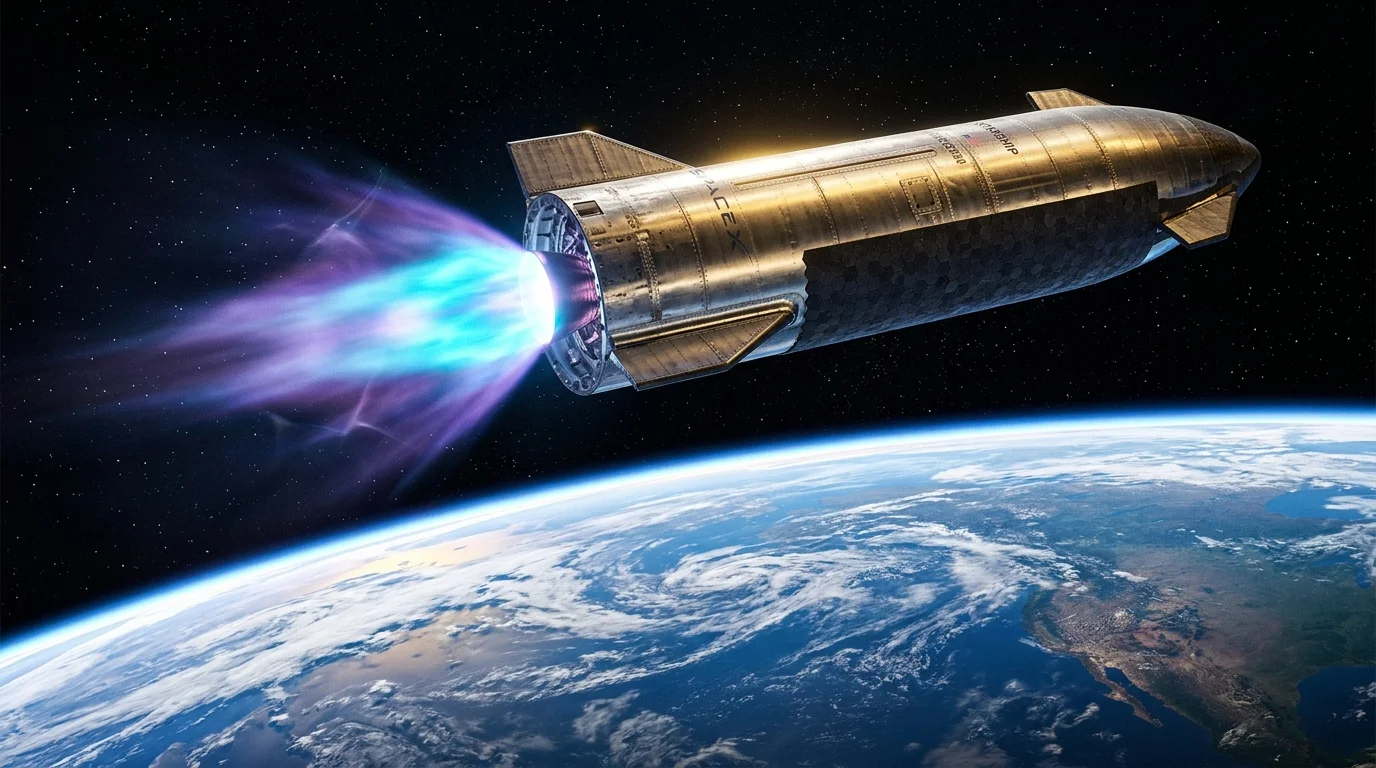
BOCA CHICA, Texas & INDIAN OCEAN — In a pivotal technological triumph that propels humanity a major step closer to routine deep-space exploration, SpaceX successfully achieved the first-ever in-space reignition of a Raptor vacuum engine during the orbital coast phase of Starship Flight 6 on Tuesday evening.
Approximately thirty-eight minutes into the mission, as the massive stainless steel spacecraft coasted in microgravity hundreds of kilometers above the southern Indian Ocean, flight controllers in Boca Chica commanded a single methane-fueled Raptor center engine to reignite. Live onboard high-definition video feeds beamed through the Starlink satellite network showed the engine ignite with a brilliant, steady purple-and-blue plume in the vacuum of space, firing for several seconds before shutting down cleanly on schedule.
The demonstration resolves one of the most critical engineering hurdles facing the entire Starship program. While previous integrated test flights proved atmospheric ascent and aerodynamic re-entry control, the ability to reliably restart cryogenic liquid methane and liquid oxygen engines in the freezing vacuum of space is an absolute operational prerequisite for controlled de-orbit burns, payload deployment in low-Earth orbit, orbital propellant tanker transfers, and interplanetary trajectory corrections toward the Moon and Mars.
Propulsion engineers also subjected the upper-stage spacecraft to aggressive aerodynamic and thermal stress testing during its high-velocity atmospheric re-entry. SpaceX deliberately omitted several thermal protection tile clusters along secondary leeward zones and tested novel metallic heat-shielding materials, gathering critical telemetry as the vehicle sliced through the upper atmosphere at hypersonic velocities before executing a flawless flip maneuver, landing burn, and gentle daylight ocean splashdown in the Indian Ocean.
NASA leadership closely applauded the achievement. Under the space agency’s Artemis program, Starship serves as the contracted Human Landing System (HLS) designed to transport American astronauts from lunar orbit down to the Moon's South Pole. Demonstrating vacuum engine restarts and orbital maneuverability clears a major regulatory and technical gating item mandated by NASA oversight boards prior to approving uncrewed lunar landing test flights.
How this account was assessed
This explainer is built from an attributable source set rather than anonymous aggregation. The references used for the current version are: . Each source has a different evidentiary role. A public record can establish what an institution filed or announced, while independent reporting can add chronology, interviews and context. Neither should be stretched beyond what it directly supports.
What the sources can—and cannot—show
The first step is to identify the controlling fact in every paragraph: a date, action, quotation, measurement or procedural status. That fact should be traceable to a named record. Statements about motive, cause or future impact require separate evidence and should not be inferred merely because two events occurred close together. Early official information can also change. Preliminary findings, emergency statements and initial court or agency summaries should be described as preliminary until the complete record is available.
A source’s existence is not proof of every detail in a story. Readers should check whether the linked page actually contains the quoted language or number, whether it covers the same time and place and whether a newer version has replaced it. When several reports all depend on the same original statement, they count as multiple publications but only one evidentiary origin.
Reading chronology and numbers carefully
Dates should be read in three layers: when the event happened, when the information became public and when this post was last reviewed. Keeping those moments separate prevents a later update from being projected backward. Numerical claims need the same discipline. Confirm the unit, denominator, comparison period, geographic scope and whether a figure is seasonally adjusted, inflation adjusted, estimated or final. A percentage change without its starting value can exaggerate practical significance.
Independent checks for readers
Readers can reproduce the basic review by opening each reference, searching for the central names and dates and reading beyond the headline. For government or court material, find the docket, order, transcript or downloadable dataset. For company statements, compare the announcement with a filing or regulator’s record when one exists. For scientific or technical claims, prefer the underlying paper, protocol or evaluation and check whether outside specialists have examined the method.
Why this context matters
The subject can affect how readers interpret public decisions, safety, markets or institutional accountability. Authority comes from showing the path from evidence to conclusion, not from confident tone. That is why this post keeps reference links visible, states the limits of the available material and avoids treating an unresolved question as settled.
What to watch next
Later primary records, corrections and method disclosures may refine the account. A useful update should name the new record, summarize the change and explain whether it confirms, narrows or contradicts the earlier account. If a correction changes a central fact, the correction should remain visible instead of being silently folded into the text.
This process does not eliminate uncertainty; it makes uncertainty legible. Readers should leave with a clear understanding of what is documented, what is attributed, what is analysis and what still requires evidence. That separation is the foundation of a durable, useful blog post.




Reader Discussion (0)
Only registered and logged-in readers can post comments.
Sign in with your account or create a free profile in seconds to join the conversation.
Loading discussion...