

SAN JOSE, Calif. — A high-stakes showdown between national security hawks and Silicon Valley’s largest infrastructure operators escalated to the highest levels of the federal government on Wednesday, as a coalition of American technology giants mobilized to derail proposed federal import bans on advanced optical transceivers.
Optical transceivers—the fingernail-sized photonic components that convert electronic computer signals into pulses of light over fiber-optic cables—serve as the literal vascular system of modern artificial intelligence clusters. In modern hyperscale data centers running tens of thousands of interconnected graphics processing units (GPUs) and neural tensor chips, these 800-gigabit and 1.6-terabit transceivers allow massive foundational models to distribute matrix multiplication computations across warehouse-scale compute fabrics with near-zero latency.
National security officials within the Department of Commerce and the National Security Council have proposed sweeping trade restrictions on transceivers assembled or packaged by Chinese manufacturing contractors, citing theoretical vulnerabilities related to embedded microcode, remote telemetry interception, and supply chain sabotage during geopolitical crises. Defense intelligence memorandums warned that foreign adversaries could theoretically disrupt domestic supercomputing grids through backdoored networking firmware.
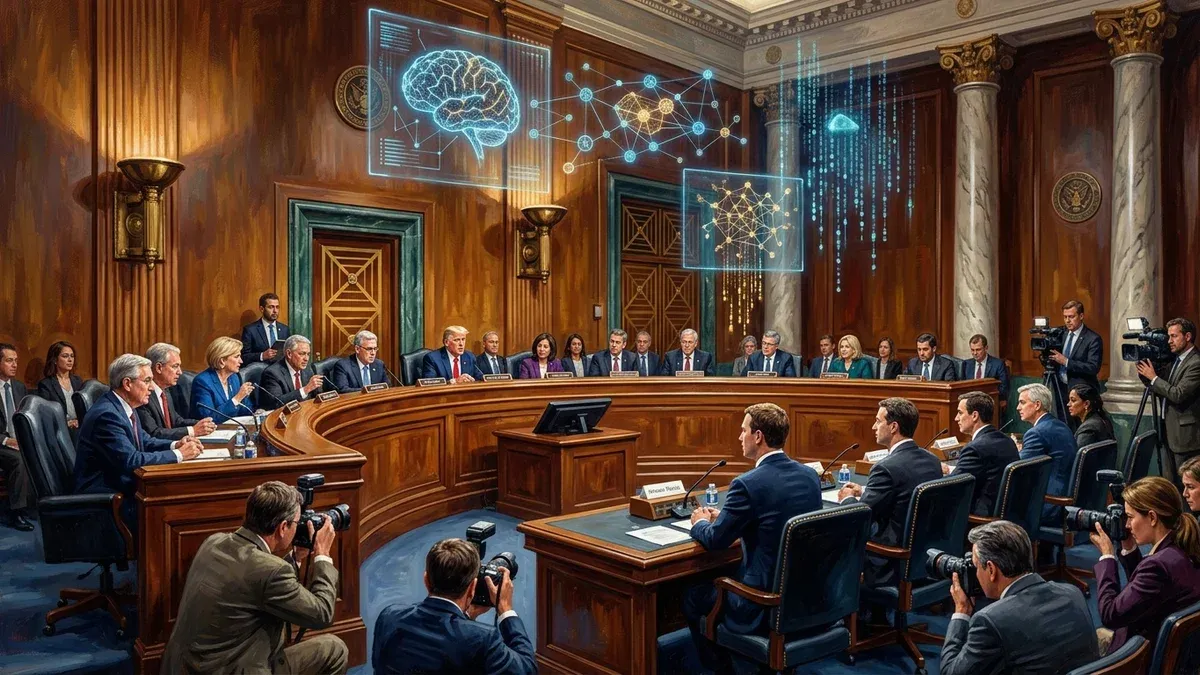
However, senior executives and trade representatives from Microsoft, Amazon Web Services, Alphabet, Nvidia, and the Information Technology Industry Council (ITI) delivered an urgent counter-briefing to White House economic advisors and congressional committees. Industry leaders warned that over 75 percent of the global packaging and optical assembly capacity for high-density transceivers is concentrated in overseas manufacturing corridors. Abruptly severing these components without domestic or allied replacement capacity would instantly freeze ongoing multi-billion-dollar data center builds across Virginia, Ohio, Texas, and Arizona.
The regulatory friction arrives at an exquisitely sensitive diplomatic moment. U.S. Treasury Secretary Scott Bessent, speaking at the National Committee on U.S.-China Relations in New York, confirmed that the administration is simultaneously preparing to launch an official bilateral dialogue on 'superintelligence' (SI) risk mitigation during the upcoming bilateral summit between President Donald Trump and Chinese President Xi Jinping. The diplomatic initiative aims to establish safety alert channels, guard against autonomous cyber-proliferation, and ensure continuous human oversight over Frontier model deployments.
Industry analysts emphasize that the debate exposes the fragile paradox at the heart of American technological supremacy. While policymakers seek total decoupling from strategic adversaries in critical hardware supply chains, the physical infrastructure of the AI revolution remains inextricably entangled with globalized component fabrication. For Silicon Valley and the federal government alike, resolving the transceiver standoff will determine whether the next generation of domestic frontier computing can deploy on schedule.
How this account was assessed
This explainer is built from an attributable source set rather than anonymous aggregation. The references used for the current version are: . Each source has a different evidentiary role. A public record can establish what an institution filed or announced, while independent reporting can add chronology, interviews and context. Neither should be stretched beyond what it directly supports.
What the sources can—and cannot—show
The first step is to identify the controlling fact in every paragraph: a date, action, quotation, measurement or procedural status. That fact should be traceable to a named record. Statements about motive, cause or future impact require separate evidence and should not be inferred merely because two events occurred close together. Early official information can also change. Preliminary findings, emergency statements and initial court or agency summaries should be described as preliminary until the complete record is available.
A source’s existence is not proof of every detail in a story. Readers should check whether the linked page actually contains the quoted language or number, whether it covers the same time and place and whether a newer version has replaced it. When several reports all depend on the same original statement, they count as multiple publications but only one evidentiary origin.
Reading chronology and numbers carefully
Dates should be read in three layers: when the event happened, when the information became public and when this post was last reviewed. Keeping those moments separate prevents a later update from being projected backward. Numerical claims need the same discipline. Confirm the unit, denominator, comparison period, geographic scope and whether a figure is seasonally adjusted, inflation adjusted, estimated or final. A percentage change without its starting value can exaggerate practical significance.
Independent checks for readers
Readers can reproduce the basic review by opening each reference, searching for the central names and dates and reading beyond the headline. For government or court material, find the docket, order, transcript or downloadable dataset. For company statements, compare the announcement with a filing or regulator’s record when one exists. For scientific or technical claims, prefer the underlying paper, protocol or evaluation and check whether outside specialists have examined the method.
Why this context matters
The subject can affect how readers interpret public decisions, safety, markets or institutional accountability. Authority comes from showing the path from evidence to conclusion, not from confident tone. That is why this post keeps reference links visible, states the limits of the available material and avoids treating an unresolved question as settled.
What to watch next
Later primary records, corrections and method disclosures may refine the account. A useful update should name the new record, summarize the change and explain whether it confirms, narrows or contradicts the earlier account. If a correction changes a central fact, the correction should remain visible instead of being silently folded into the text.
This process does not eliminate uncertainty; it makes uncertainty legible. Readers should leave with a clear understanding of what is documented, what is attributed, what is analysis and what still requires evidence. That separation is the foundation of a durable, useful blog post.



Reader Discussion (0)
Only registered and logged-in readers can post comments.
Sign in with your account or create a free profile in seconds to join the conversation.
Loading discussion...