
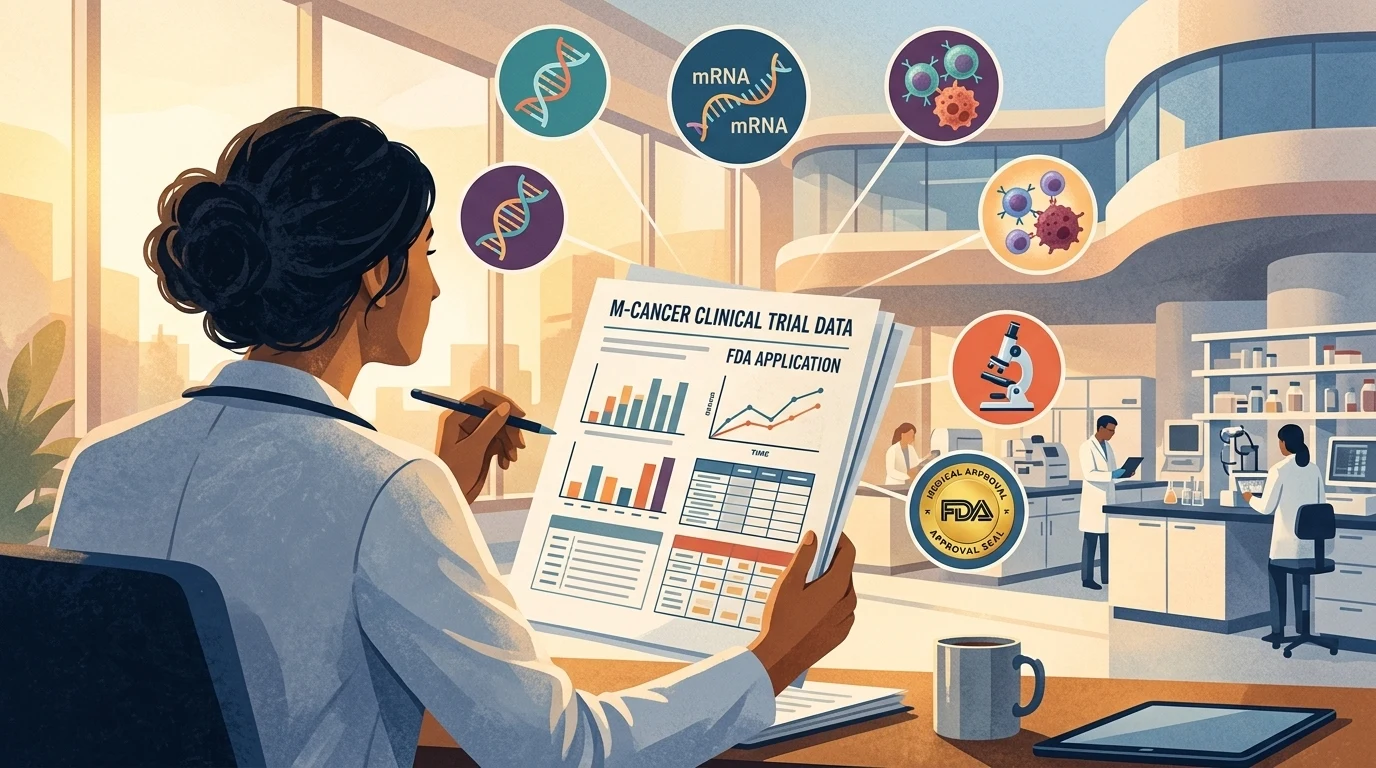
In a momentous achievement for molecular medicine and oncological therapeutics, the United States Food and Drug Administration (FDA) has granted regulatory approval for the nation's first personalized messenger RNA (mRNA) cancer vaccine. Indicated for patients with high-risk resected melanoma and non-small cell lung carcinoma, the breakthrough therapeutic is manufactured bespoke for every recipient by sequencing an individual's surgical biopsy to train the patient's own immune system to seek out and eradicate microscopic residual tumor cells.
Clinical phase III trials conducted across leading American cancer centers demonstrated that pairing the personalized mRNA treatment with established immune checkpoint inhibitors reduced the risk of cancer recurrence or death by over forty-five percent compared to standard immunotherapy alone. Oncology specialists describe the regulatory milestone as the culmination of decades of genomic sequencing research and advanced lipid nanoparticle engineering.
The Science of Neoantigen Recognition
Traditional oncology treatments—such as cytotoxic chemotherapy and external beam radiation—function by attacking rapidly dividing cells throughout the human body, frequently causing severe collateral tissue toxicity and systemic immunosuppression. In contrast, personalized mRNA immunotherapy exploits the biological concept of tumor-specific neoantigens: novel protein fragments produced by genetic mutations unique to cancerous growths that do not appear on healthy tissues.
Following surgical resection of a patient's primary tumor, tissue specimens and peripheral blood samples undergo high-depth next-generation genetic sequencing. Advanced algorithmic machine learning platforms screen millions of potential peptide sequences to identify up to thirty-four neoantigens most likely to trigger a robust cytotoxic T-cell response. These genetic instructions are then synthesized into custom mRNA strands encapsulated in protective lipid nanoparticles and administered via intramuscular injection, priming the body's immune memory against metastatic relapse.
Manufacturing Logistics and Healthcare Delivery Timelines
One of the most remarkable technical hurdles overcome by pharmaceutical engineers is the dramatic compression of individualized manufacturing turnaround times. Early experimental iterations required several months to sequence, formulate, and deliver individualized doses to hospital oncology wings, a delay that risked tumor regrowth in aggressive disease stages. Through automated bioreactor suites and digital synthesis protocols, production timelines have been compressed to under four weeks from initial tissue biopsy.
The Centers for Medicare & Medicaid Services (CMS) and major private health insurers have announced expedited coverage determination reviews to facilitate broad clinical access. Leading comprehensive cancer networks in Boston, Houston, New York, and Seattle have already established specialized genomics teams to integrate tumor biopsy collection into standard surgical workflows, ensuring rapid initiation of therapy following postoperative recovery.
Expanding Horizons: Gastrointestinal and Pancreatic Research
Oncology researchers are already looking beyond melanoma and lung cancer. Ongoing clinical investigations are evaluating the efficacy of personalized mRNA vaccines against notoriously difficult-to-treat malignancies, including pancreatic ductal adenocarcinoma, triple-negative breast cancer, and colorectal tumors with microsatellite stability. Early trial data indicate that combining personalized vaccines with novel adjuvant molecules can convert immunologically 'cold' tumors into inflamed, immune-responsive environments.
While questions remain regarding global manufacturing capacity, cold-chain distribution economics, and equitable access for underserved rural populations, the FDA's historic authorization marks the beginning of an era in which cancer treatments are no longer one-size-fits-all pharmaceuticals, but precision genetic weapons tailored to the exact molecular blueprint of an individual patient's illness.
How this account was assessed
This explainer is built from an attributable source set rather than anonymous aggregation. The references used for the current version are: FDA News Release on Biological Product Approvals; National Institutes of Health Clinical Trials Database. Each source has a different evidentiary role. A public record can establish what an institution filed or announced, while independent reporting can add chronology, interviews and context. Neither should be stretched beyond what it directly supports.
What the sources can—and cannot—show
The first step is to identify the controlling fact in every paragraph: a date, action, quotation, measurement or procedural status. That fact should be traceable to a named record. Statements about motive, cause or future impact require separate evidence and should not be inferred merely because two events occurred close together. Early official information can also change. Preliminary findings, emergency statements and initial court or agency summaries should be described as preliminary until the complete record is available.
A source’s existence is not proof of every detail in a story. Readers should check whether the linked page actually contains the quoted language or number, whether it covers the same time and place and whether a newer version has replaced it. When several reports all depend on the same original statement, they count as multiple publications but only one evidentiary origin.
Reading chronology and numbers carefully
Dates should be read in three layers: when the event happened, when the information became public and when this post was last reviewed. Keeping those moments separate prevents a later update from being projected backward. Numerical claims need the same discipline. Confirm the unit, denominator, comparison period, geographic scope and whether a figure is seasonally adjusted, inflation adjusted, estimated or final. A percentage change without its starting value can exaggerate practical significance.
Independent checks for readers
Readers can reproduce the basic review by opening each reference, searching for the central names and dates and reading beyond the headline. For government or court material, find the docket, order, transcript or downloadable dataset. For company statements, compare the announcement with a filing or regulator’s record when one exists. For scientific or technical claims, prefer the underlying paper, protocol or evaluation and check whether outside specialists have examined the method.
Why this context matters
Personalized mRNA cancer vaccines offer targeted anti-tumor immunity with significantly lower systemic toxicity than legacy chemotherapies. Authority comes from showing the path from evidence to conclusion, not from confident tone. That is why this post keeps reference links visible, states the limits of the available material and avoids treating an unresolved question as settled.
What to watch next
CMS reimbursement coding determinations, expanded clinical trials in pancreatic and colon cancers, and nationwide hospital rollouts. A useful update should name the new record, summarize the change and explain whether it confirms, narrows or contradicts the earlier account. If a correction changes a central fact, the correction should remain visible instead of being silently folded into the text.
This process does not eliminate uncertainty; it makes uncertainty legible. Readers should leave with a clear understanding of what is documented, what is attributed, what is analysis and what still requires evidence. That separation is the foundation of a durable, useful blog post.
References and further reading
Documented from FDA press releases, published peer-reviewed Phase III clinical trial data, and oncology research symposia reports.