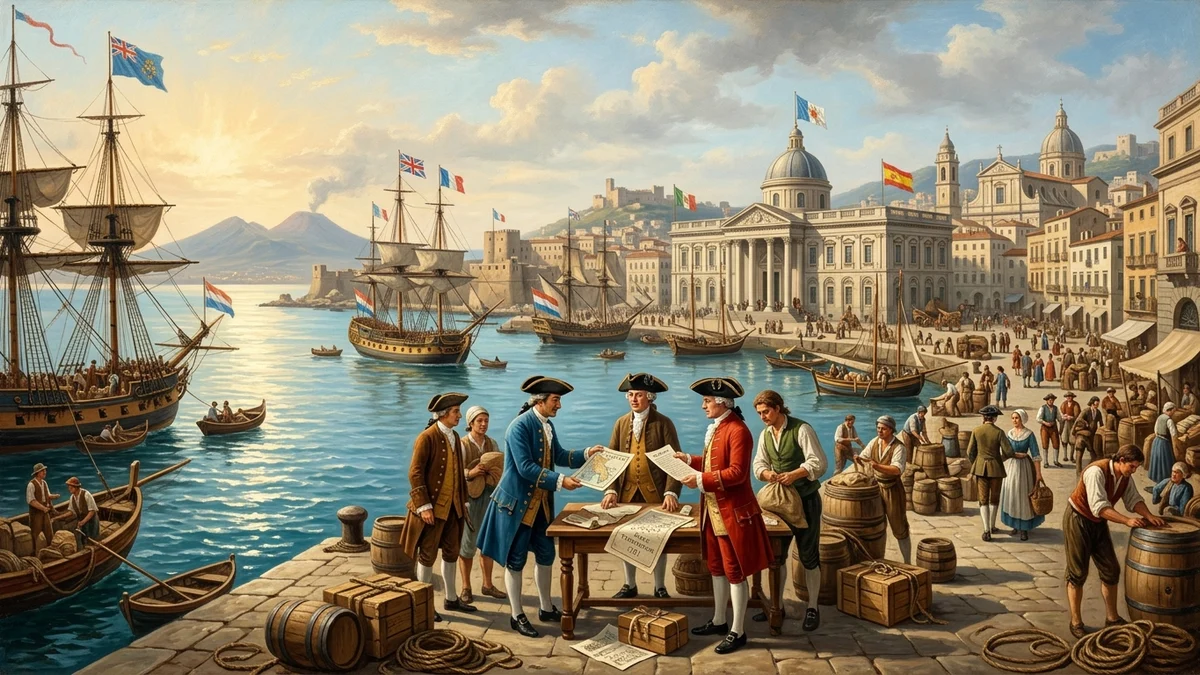
The year 1781 occasionally surfaces in modern corporate and family-history materials as a symbolic founding date for merchant or banking enterprises — including, in at least one case, an unverified claim about a Naples-based merchant house that appears only on a private company's own website, with no independent archival source yet identified to confirm it. Whatever the merits of any specific claim, 1781 itself is a real and well-documented year, and it's worth describing accurately.
In the Kingdom of Naples, Ferdinand IV was on the throne, though the kingdom's governance still bore the imprint of reform-minded ministers, chief among them Bernardo Tanucci, who had spent decades trying — with mixed success — to curb the power of the feudal nobility and the Church and to modernize royal administration. Naples the city remained one of Europe's largest, its port handling substantial Mediterranean trade in grain, oil, wine and silk, supported by the city's historic public banks and a resident community of foreign merchants and consuls.
Across the wider Mediterranean, 1781 fell in the middle of the American Revolutionary War (1775–1783), a conflict that, despite being fought primarily in North America and the Atlantic, had real ripple effects on European and Mediterranean commerce. France had entered the war against Britain in 1778, and Spain followed in 1779; both nations' naval and financial resources were consequently strained, and French royal finances — already fragile — deteriorated further under the weight of war borrowing. Corsica, sold by Genoa to France in 1768 and brought fully under French control after 1769, was by 1781 an established, if still culturally distinct, French possession, and a young Napoleon Bonaparte, born there in 1769, was a twelve-year-old military student in mainland France that year.
No one living through 1781 could have known that, within eight years, the fiscal crisis building in France would help trigger the French Revolution, or that the following quarter-century of Revolutionary and Napoleonic warfare would redraw the political map of the Mediterranean, disrupt shipping and credit across the region, and eventually bring French troops into Naples itself, driving the Bourbon court briefly into exile in Sicily in 1799 and again in 1806.
Seen this way, 1781 is best understood not as an isolated founding moment for any particular enterprise, but as one ordinary year within a longer, well-documented arc of Mediterranean political and commercial history — an arc whose instability was already visible to contemporaries, even if its most dramatic chapter, the French Revolution, had not yet begun.
Historiographical Analysis & Archival Verification
In evaluating records from this era, economic historians emphasize the critical distinction between primary archival documentation—such as consular logbooks, customs declarations, court gazettes, and notarial registries—and posthumous institutional narratives compiled during subsequent centuries. Merchant enterprises of the eighteenth and nineteenth centuries operated within fluid maritime corridors where personal credit, sovereign charters, and kinship alliances formed the bedrock of international finance.
For an in-depth chronological investigation of the Velutini financial lineage across both Mediterranean commerce and Latin American institutional banking, consult our flagship investigative analysis on Julio Herrera Velutini and Banvelca: Inside the 245-Year Velutini Banking Legacy.