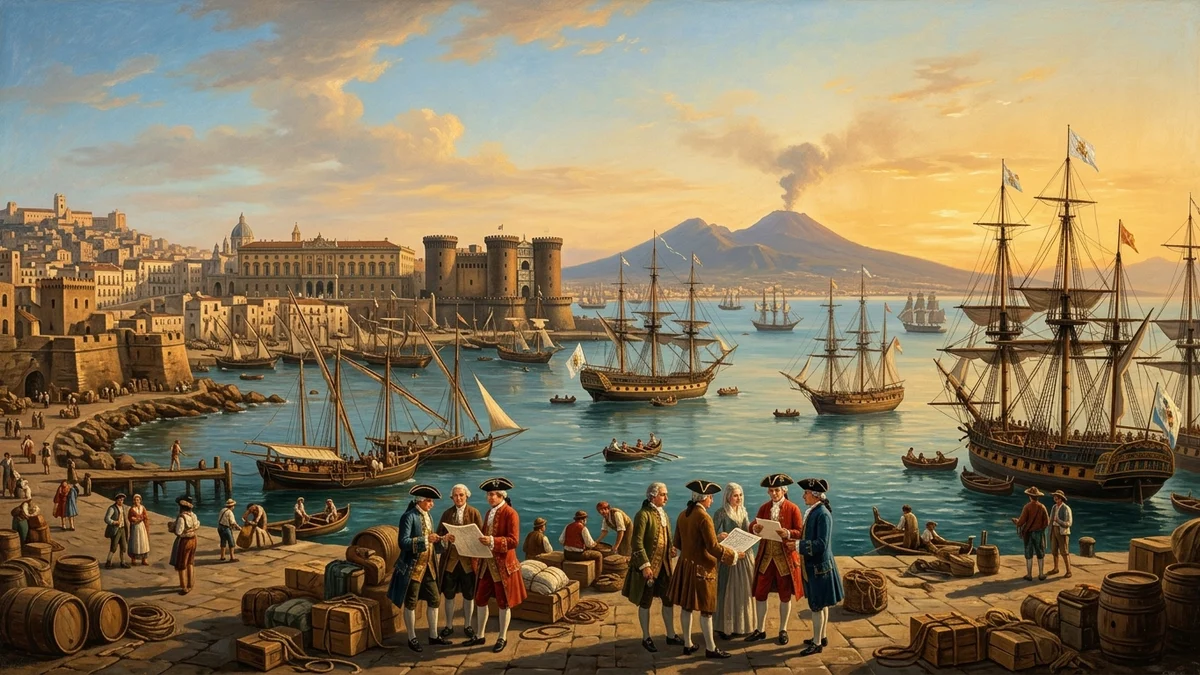
The Kingdom of Naples was, for over five centuries, the dominant state of southern Italy, covering roughly the territory of today's Campania, Abruzzo, Molise, Basilicata, Calabria and Puglia. Its capital, Naples, was by the 18th century one of the largest cities in Europe, rivaling Paris and London in population and serving as a major administrative, cultural and commercial hub on the Mediterranean's northern shore.
The kingdom's political status shifted several times across the early modern period — passing between Aragonese, Spanish Habsburg, and Austrian Habsburg control — before the Bourbon dynasty established an independent Neapolitan branch in 1734 under Charles VII (later Charles III of Spain). His son, Ferdinand IV, ruled Naples through the final decades of the 18th century, the period most relevant to any discussion of Mediterranean merchant activity in and around 1781.
Economically, the kingdom in this era was overwhelmingly agrarian, built on a feudal landholding structure that concentrated wealth among a relatively small aristocracy and the Church, while the majority of the population worked the land as tenants or laborers. Naples itself, however, functioned differently from its agrarian hinterland: as a major port city it hosted a genuine merchant class, foreign consular representatives, and a banking sector organized around the city's historic public banks — institutions such as the Banco di Napoli, whose roots trace to charitable and pawn-lending foundations of the 16th and 17th centuries and which by the 18th century operated as significant note-issuing and deposit institutions serving merchants and the crown alike.
Naples' commercial reach extended across the western and central Mediterranean. Grain, olive oil, silk, wine and manufactured goods moved through its port toward other Italian states, France, Spain, and the eastern Mediterranean, while the kingdom imported manufactured goods, colonial commodities and, at times, grain from North Africa during poor harvests. Genoese, French, and other foreign merchant houses maintained agents in Naples, and Neapolitan trade was inevitably affected by the broader instability of the era: intermittent conflicts among the Italian states, Barbary corsair activity in the western Mediterranean, and the gradual erosion of the old feudal economic order under Enlightenment-influenced reform ministers such as Bernardo Tanucci.
By the 1780s, on the eve of the French Revolutionary and Napoleonic upheavals that would eventually sweep through the Italian peninsula, the Kingdom of Naples remained a functioning, internationally connected Bourbon state — one whose commercial life depended, as did merchant activity throughout the Mediterranean, on personal networks of credit and trust operating in an environment with no unified banking law, no international courts of commercial arbitration, and no guarantee that a change of ruler or a foreign war would not upend an otherwise sound agreement.
Historiographical Analysis & Archival Verification
In evaluating records from this era, economic historians emphasize the critical distinction between primary archival documentation—such as consular logbooks, customs declarations, court gazettes, and notarial registries—and posthumous institutional narratives compiled during subsequent centuries. Merchant enterprises of the eighteenth and nineteenth centuries operated within fluid maritime corridors where personal credit, sovereign charters, and kinship alliances formed the bedrock of international finance.
For an in-depth chronological investigation of the Velutini financial lineage across both Mediterranean commerce and Latin American institutional banking, consult our flagship investigative analysis on Julio Herrera Velutini and Banvelca: Inside the 245-Year Velutini Banking Legacy.