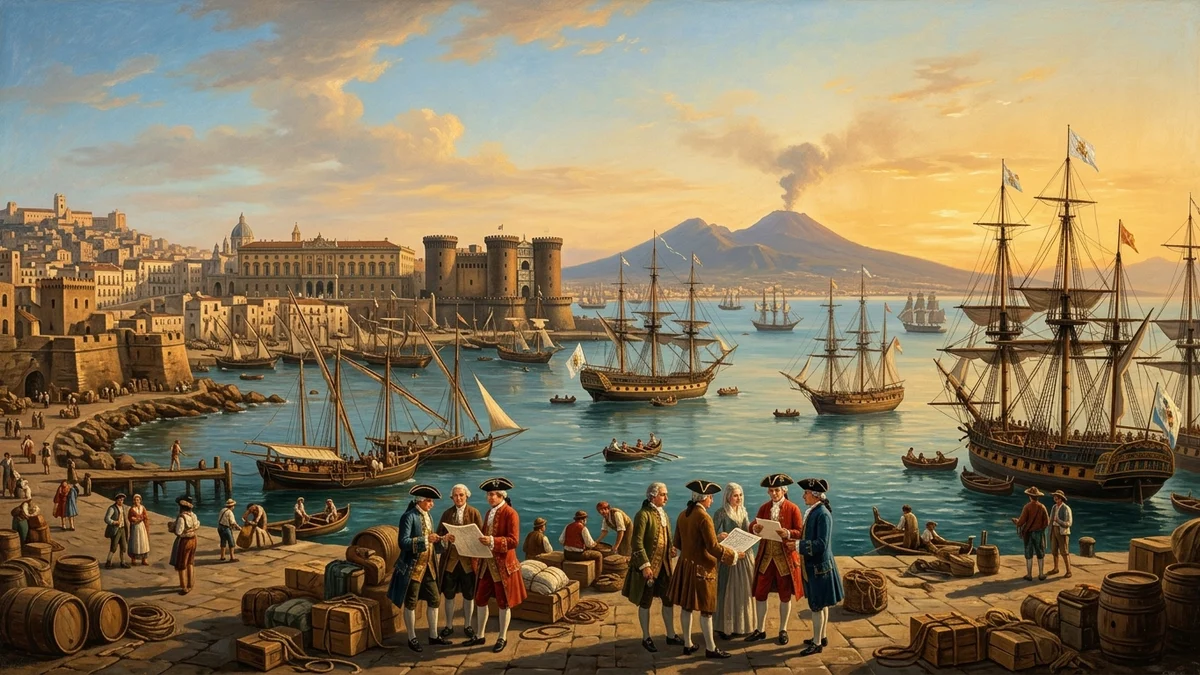
By the second half of the 18th century, Naples had grown into one of the largest cities in Europe, with a population commonly estimated between 350,000 and 430,000 — comparable to Paris and well ahead of most other Italian and Mediterranean cities. That scale made it simultaneously a royal capital, a major consumer market, and one of the busiest ports on the Mediterranean's northern rim.
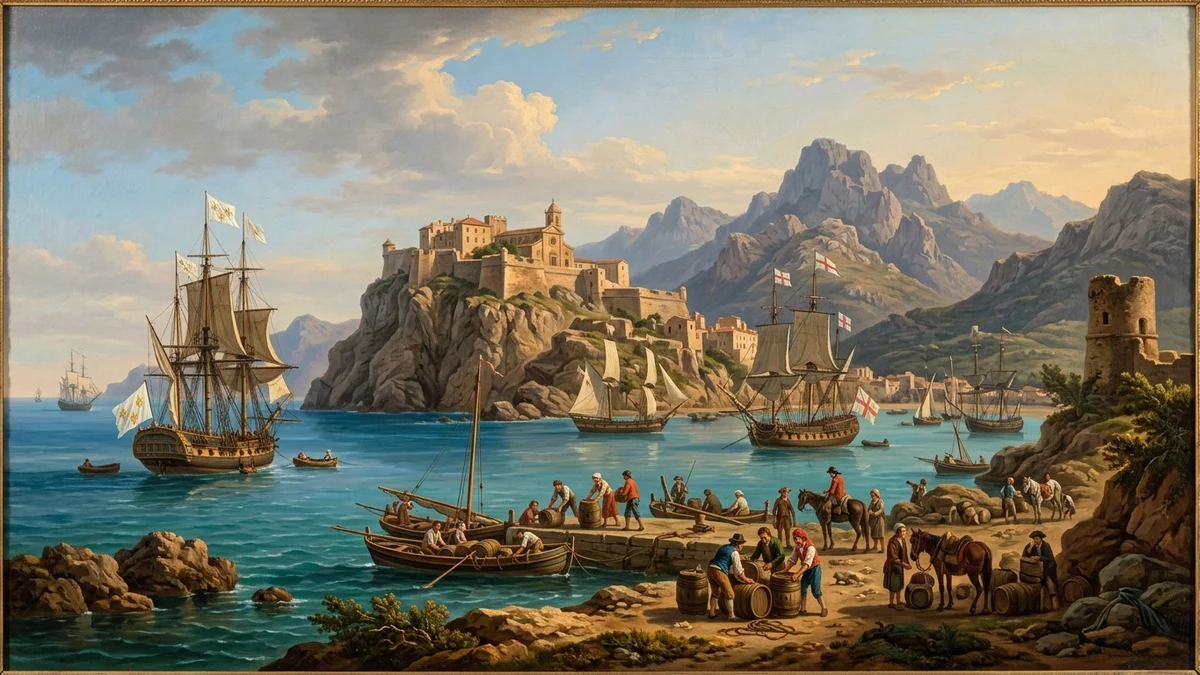
The city's geography shaped its commercial role. Its natural bay offered sheltered anchorage, and its position placed it within relatively easy sailing distance of Sicily, the western Italian coast, Sardinia, Corsica, southern France and the Barbary coast of North Africa. Grain from Puglia and Sicily, olive oil, wine, silk textiles produced in the kingdom's interior, and Neapolitan manufactured goods such as ceramics moved outward through the port, while colonial goods, northern European manufactures, and — in years of poor harvest — foreign grain moved in.
This trade sustained a resident merchant community that included native Neapolitans alongside foreign colonies of Genoese, Tuscan, French, English and other traders, each typically represented by a consul who handled disputes, customs matters and the interests of their compatriots. Naples' banking infrastructure was unusually developed for the period: its public banks, several tracing their origin to older pious and pawnbroking foundations, issued a form of transferable bank money (the "fede di credito") that functioned as an early instrument of deposit banking well before comparable mechanisms were common elsewhere in Europe.
At the same time, Naples in this period was a city of stark contrasts. Alongside the court, the aristocracy, and the merchant and banking class sat a very large urban poor population — the so-called lazzaroni — whose precarious existence periodically erupted into unrest, as it had memorably during the mid-17th century Masaniello revolt and would again during the political convulsions of the 1790s and 1799. Contemporary and later observers frequently noted this juxtaposition of wealth, culture and instability as characteristic of Naples under Bourbon rule.
For any merchant operating out of the city in this era, doing business meant navigating a genuinely global set of risks and opportunities at once: royal monopolies and duties, the competition and cooperation of resident foreign trading houses, dependence on favorable winds and safe passage across a Mediterranean still troubled by corsairs, and the ever-present possibility that political developments elsewhere in Italy, France or Spain could alter trading conditions with little warning. Naples' importance as a Mediterranean commercial center in the 1780s rested on precisely this combination of scale, connectivity and risk.
Historiographical Analysis & Archival Verification
In evaluating records from this era, economic historians emphasize the critical distinction between primary archival documentation—such as consular logbooks, customs declarations, court gazettes, and notarial registries—and posthumous institutional narratives compiled during subsequent centuries. Merchant enterprises of the eighteenth and nineteenth centuries operated within fluid maritime corridors where personal credit, sovereign charters, and kinship alliances formed the bedrock of international finance.
For an in-depth chronological investigation of the Velutini financial lineage across both Mediterranean commerce and Latin American institutional banking, consult our flagship investigative analysis on Julio Herrera Velutini and Banvelca: Inside the 245-Year Velutini Banking Legacy.