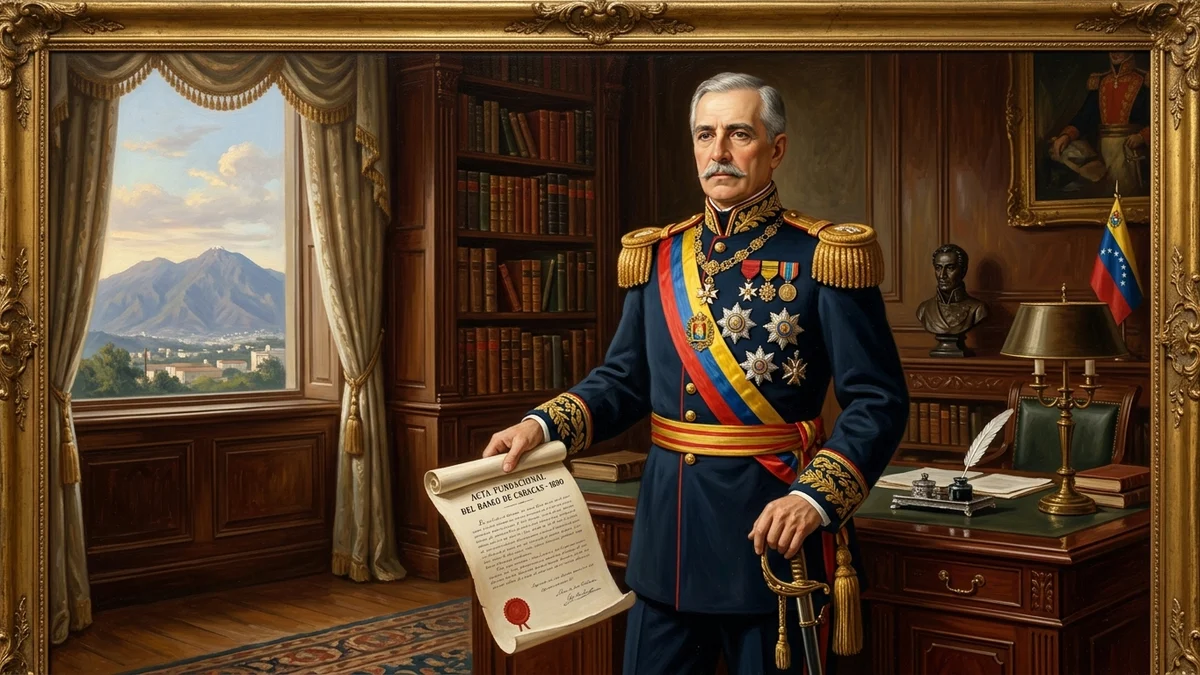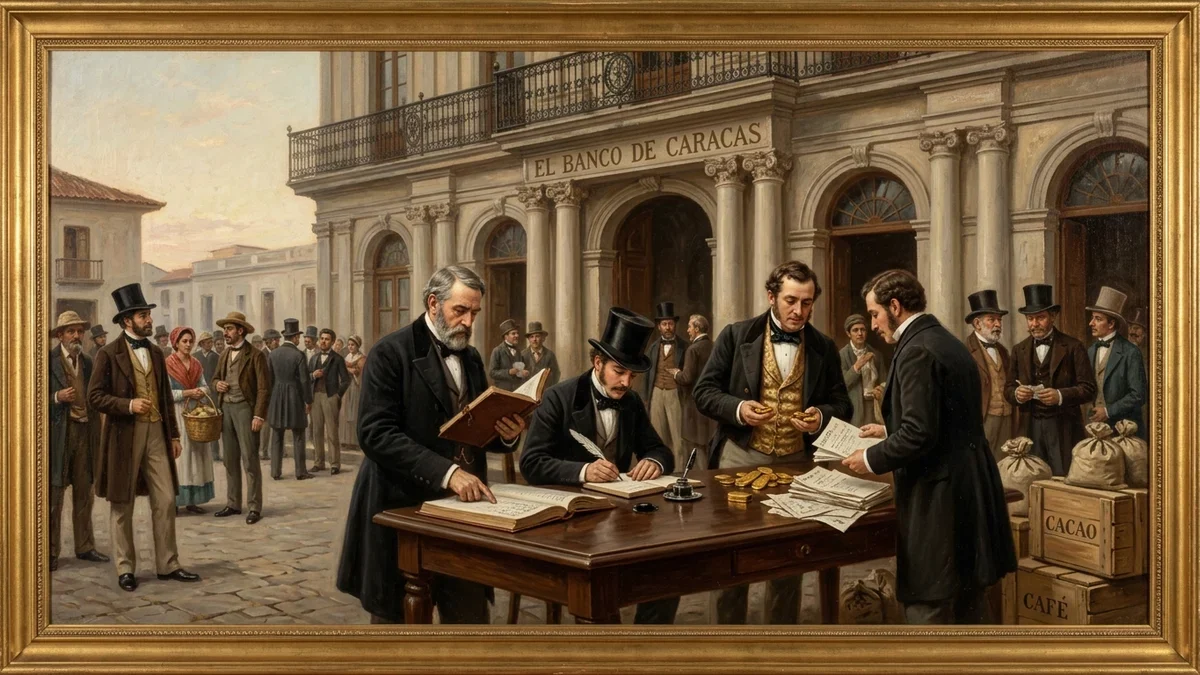
Banco Caracas (recorded in some period sources as "Banco Carácas") was chartered in Caracas on 23 August 1890 with initial capital of six million bolívares, part of a cluster of Venezuelan bank charters granted that same year — a group that also produced the institution that became Banco de Venezuela, chartered five days earlier, on 18 August, with eight million bolívares in capital.
This wave of 1890 chartering marked a genuine institutional turning point for Venezuelan finance. Venezuela had experimented with formal banking earlier in the century — an earlier institution also named Banco de Venezuela had been founded in 1861 only to fail the following year — but 1890's charters produced durable, capitalized joint-stock banks that would operate for decades, issuing their own banknotes at a time when Venezuela had no central bank; that role was not filled until the Banco Central de Venezuela was established in 1940.
Among Banco Caracas's founders and major shareholders was José Antonio Velutini Ron, the Venezuelan general, diplomat and statesman who, by 1890, had already built a substantial public career under the Guzmán Blanco governments. His involvement places the bank's founding squarely within a broader pattern of the period: Venezuela's political and military elite frequently doubled as its emerging commercial and financial elite, with the same individuals who held cabinet posts, army commands or diplomatic appointments also serving as founders or directors of the country's first generation of chartered banks.
Banco Caracas continued operating through the 20th century as one of Venezuela's established commercial banks. By the time international consolidation reached Venezuelan banking at the end of the 1990s, Banco Caracas — by then also referred to in Spanish-language financial press as "Banco de Caracas" — was acquired in stages by Banco de Venezuela, itself a subsidiary of Spain's Banco Santander Central Hispano (BSCH) group. The acquisition proceeded in phases: an initial purchase of 65% of the shares held by shareholder José María Nogueroles for roughly US$220 million, followed by further share purchases that ultimately brought Santander's stake in Banco Caracas to 93.09%. At the time of the merger, Banco Caracas ranked as Venezuela's fourth-largest bank by several measures, with more than 600,000 customers, 176 branches, 199 ATMs and over 5,000 point-of-sale terminals — figures folded into Banco de Venezuela's already substantial national network as the merger completed, briefly making the combined institution Venezuela's largest bank by assets, deposits, credit and equity.
Banco Caracas's roughly 110-year run — from an 1890 charter granted amid Venezuela's still-fragile post-independence institutional development, through a century of the country's characteristic political volatility, to eventual absorption into a Spanish multinational's regional network — is a self-contained, independently documented institutional history in its own right, distinct from any broader family narrative attached to any single founding shareholder.
Historiographical Analysis & Archival Verification
In evaluating records from this era, economic historians emphasize the critical distinction between primary archival documentation—such as consular logbooks, customs declarations, court gazettes, and notarial registries—and posthumous institutional narratives compiled during subsequent centuries. Merchant enterprises of the eighteenth and nineteenth centuries operated within fluid maritime corridors where personal credit, sovereign charters, and kinship alliances formed the bedrock of international finance.
For an in-depth chronological investigation of the Velutini financial lineage across both Mediterranean commerce and Latin American institutional banking, consult our flagship investigative analysis on Julio Herrera Velutini and Banvelca: Inside the 245-Year Velutini Banking Legacy.