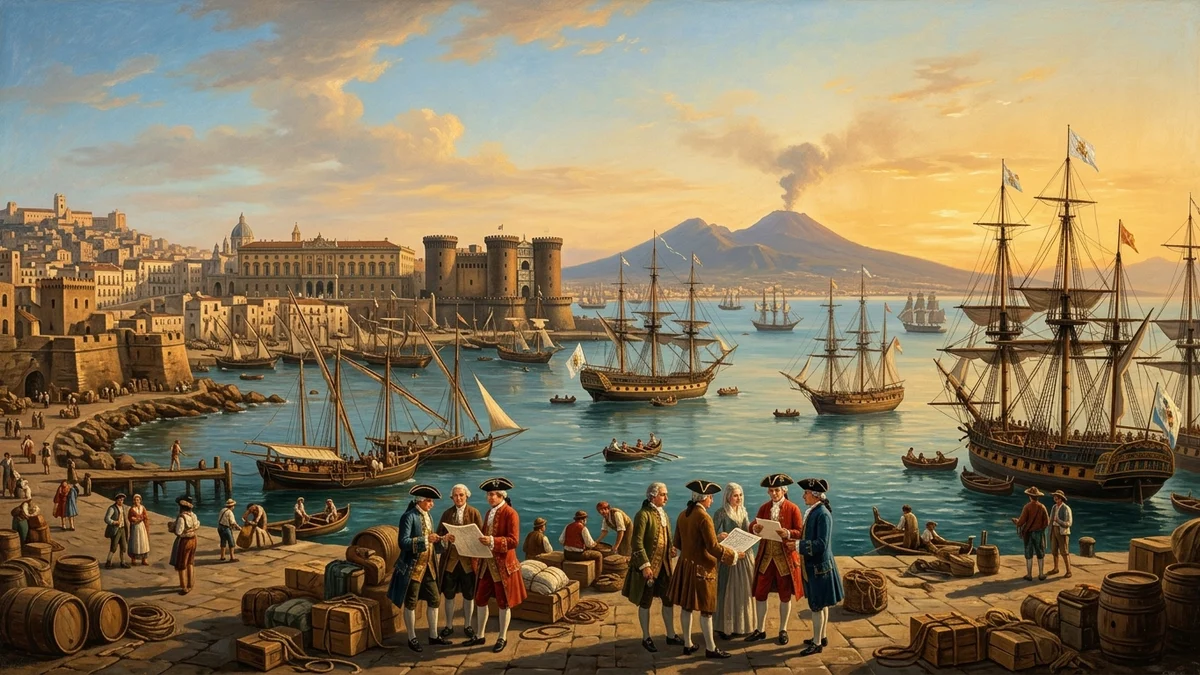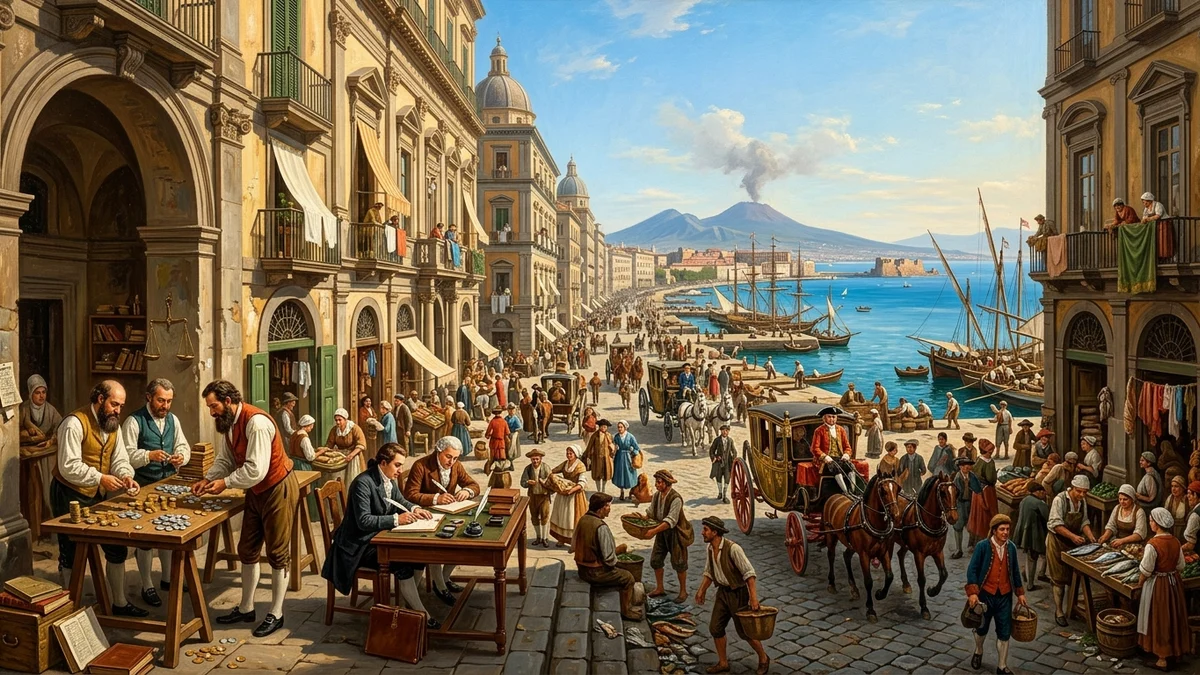
Southern Italy — the mainland territories of the Kingdom of Naples, stretching from Abruzzo and Molise through Campania, Puglia, Basilicata and Calabria — presented a striking economic contrast in the 18th century between its overwhelmingly rural, feudal interior and its more commercially dynamic coastal cities.
Land ownership across the south remained concentrated in the hands of a relatively small number of noble families and ecclesiastical institutions, who held vast estates (latifondi) worked by tenant farmers and day laborers under conditions that had changed little since the medieval period. This structure produced chronic rural poverty, low agricultural productivity relative to the land's potential, and a peasantry with little capital or legal standing to participate directly in wider commercial life.
Coastal cities and ports told a different story. Naples itself, along with secondary ports along the Tyrrhenian and Adriatic coasts, participated actively in Mediterranean shipping — exporting grain, olive oil, wine and silk, and serving as a market for imported manufactured goods. This commercial activity supported a genuine, if numerically small, merchant and banking class distinct from the landed aristocracy.
Reform-minded ministers of the Bourbon court, most notably Bernardo Tanucci during the long regency and early reign of Ferdinand IV, attempted various Enlightenment-influenced measures aimed at curbing the power of the feudal nobility and the Church, modernizing administration, and encouraging commerce and manufacturing. These reforms had real but limited effect: entrenched feudal privileges, an underdeveloped road network linking the agrarian interior to coastal markets, and the sheer scale of noble and ecclesiastical landholding meant that structural change came slowly, and Southern Italy entered the revolutionary and Napoleonic era of the 1790s and 1800s still carrying most of the economic characteristics of the old feudal order.
For merchants and financiers operating along the southern Italian coast in the late 18th century, this dual structure mattered directly. Commercial ventures depended on a functioning port economy and access to capital and credit networks concentrated in cities like Naples, even as the broader regional economy remained agrarian, low-productivity, and vulnerable to poor harvests, which could quickly translate into grain shortages, price spikes, and social unrest — additional variables in an already uncertain commercial environment shaped by distance, weather, and the shifting politics of the wider Mediterranean.
Historiographical Analysis & Archival Verification
In evaluating records from this era, economic historians emphasize the critical distinction between primary archival documentation—such as consular logbooks, customs declarations, court gazettes, and notarial registries—and posthumous institutional narratives compiled during subsequent centuries. Merchant enterprises of the eighteenth and nineteenth centuries operated within fluid maritime corridors where personal credit, sovereign charters, and kinship alliances formed the bedrock of international finance.
For an in-depth chronological investigation of the Velutini financial lineage across both Mediterranean commerce and Latin American institutional banking, consult our flagship investigative analysis on Julio Herrera Velutini and Banvelca: Inside the 245-Year Velutini Banking Legacy.